

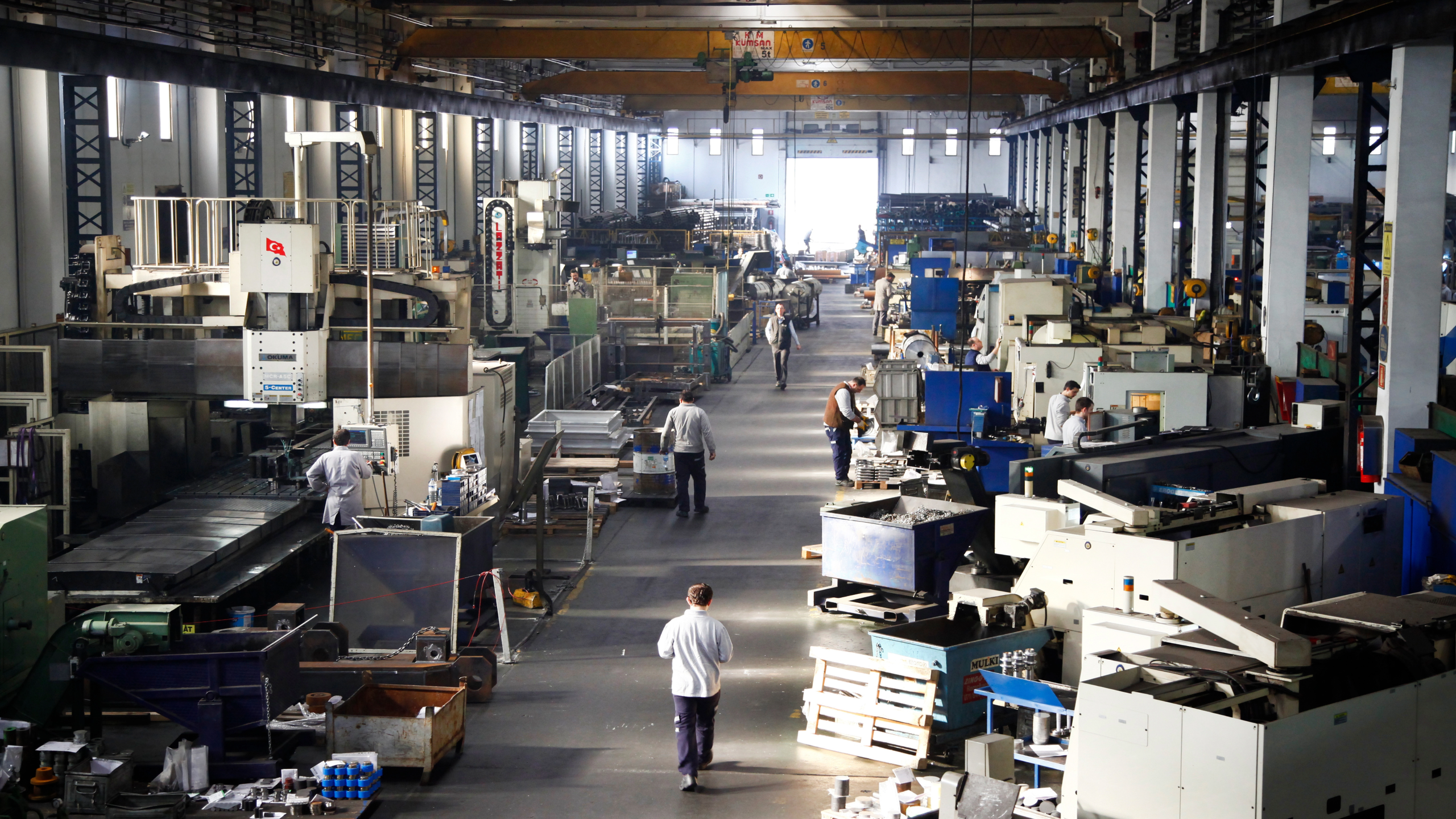
For businesses looking to bring products to market without managing production in-house, two popular outsourcing models stand out: contract manufacturing and private label manufacturing. While both approaches allow companies to leverage third-party expertise, they serve different purposes and offer distinct benefits. As a leading contract manufacturer with facilities in China, Vietnam, and Thailand, E-BI specializes in delivering tailored manufacturing solutions for Original Equipment Manufacturers (OEMs) across industries like electronics, medical devices, and automotive. This article explores the key differences between contract manufacturing and private label manufacturing, helping you choose the right strategy for your business and highlighting how E-BI can support your production goals.
What Is Contract Manufacturing?
Contract manufacturing involves outsourcing part or all of a product’s production process to a third-party manufacturer, known as a contract manufacturer (CM). The OEM designs the product and specifies requirements, while the CM handles manufacturing tasks such as component fabrication, assembly, or full-scale production. This model is ideal for businesses seeking customized products tailored to their specifications. The global contract manufacturing market is expected to reach $1.2 trillion by 2027, driven by demand for cost efficiency and scalability (Grand View Research).
For example, E-BI provides end-to-end contract manufacturing services, from PCB assembly to plastic injection molding, allowing OEMs to maintain control over product design while leveraging E-BI’s expertise and infrastructure in Asia. Contract manufacturing is common in industries requiring high precision and regulatory compliance, such as medical devices and automotive (Thomasnet).
What Is Private Label Manufacturing?
Private label manufacturing involves purchasing pre-made products from a manufacturer and branding them as your own. The manufacturer produces standardized or slightly modified products, which the buyer markets under their brand name without significant input into the design or production process. This model is popular in industries like consumer goods, cosmetics, and food and beverage, where speed to market and low costs are priorities. The private label market is projected to grow to $250 billion in the U.S. by 2027, reflecting its appeal for retailers and e-commerce businesses (Statista).
For instance, a retailer might partner with a private label manufacturer to produce generic skincare products, which are then sold under the retailer’s brand with custom packaging. Unlike contract manufacturing, private label manufacturing focuses on existing products with minimal customization (Forbes).
Key Differences Between Contract Manufacturing and Private Label
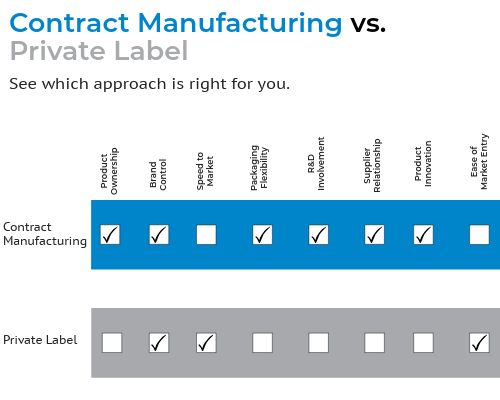
While both models involve outsourcing production, they differ in purpose, customization, control, and target audience. The table below summarizes the key differences:
| Aspect | Contract Manufacturing | Private Label Manufacturing |
|---|---|---|
| Definition | Outsourcing custom product production to a manufacturer based on OEM specifications. | Buying pre-made products and branding them as your own with minimal changes. |
| Customization | High; products are designed and manufactured to OEM specifications. | Low; products are standardized with minor tweaks (e.g., packaging, branding). |
| Control | OEM retains control over design, materials, and quality standards. | Limited control; manufacturer dictates product specifications. |
| Target Audience | OEMs in technical industries (e.g., electronics, medical devices, automotive). | Retailers, e-commerce businesses, and consumer goods brands. |
| Cost | Higher due to customization but cost-effective compared to in-house production. | Lower due to standardized products and economies of scale. |
| Time-to-Market | Longer due to design and prototyping phases. | Faster, as products are ready-made. |
| Examples | Custom PCB assembly, medical device production. | Branded cosmetics, packaged foods. |
This comparison highlights that contract manufacturing is suited for businesses requiring unique, high-quality products, while private label manufacturing is ideal for those seeking quick, cost-effective market entry with standardized goods (McKinsey).
Benefits of Contract Manufacturing
Contract manufacturing offers several advantages for OEMs, particularly those in technical industries. Here are the key benefits:
- Customization: OEMs have full control over product design, materials, and quality, ensuring products meet specific requirements. E-BI collaborates with clients to produce custom electronics and medical devices to exact specifications (Thomasnet).
- Quality Assurance: CMs like E-BI adhere to strict standards, such as ISO 9001 and ISO 13485, ensuring high-quality production for industries like automotive and healthcare (ISO).
- Scalability: Contract manufacturing allows OEMs to scale production without investing in facilities, ideal for high-growth industries like electronics (Electronics Weekly).
- Expertise: CMs bring specialized skills and advanced technologies, such as IoT and AI, to optimize production processes (McKinsey).
Benefits of Private Label Manufacturing
Private label manufacturing is attractive for businesses focused on branding and market speed. Key benefits include:
- Low Cost: Standardized products reduce production costs, making private labeling affordable for startups and retailers. For example, private label cosmetics can be produced for as low as $2–$5 per unit (Forbes).
- Speed to Market: Ready-made products enable rapid market entry, critical for consumer goods like food and apparel (Statista).
- Minimal R&D: Businesses avoid the costs and time of product development, focusing instead on marketing and branding.
- Brand Focus: Private labeling allows companies to build brand recognition without managing production complexities (Thomasnet).
When to Choose Contract Manufacturing
Contract manufacturing is the preferred choice for businesses that:
- Require custom-designed products with specific features, such as medical devices or automotive components.
- Operate in industries with strict regulatory requirements, such as FDA or UL standards.
- Need scalability and flexibility to meet fluctuating demand, common in electronics and industrial equipment.
- Want to leverage advanced manufacturing technologies and expertise, such as those offered by E-BI in Asia.
For example, an OEM developing a new smart home device would benefit from contract manufacturing to ensure precise PCB assembly and compliance with safety standards. E-BI excels in delivering such tailored solutions, with facilities in China, Vietnam, and Thailand optimized for technical manufacturing (Electronics Weekly).
When to Choose Private Label Manufacturing
Private label manufacturing is ideal for businesses that:
- Want to enter markets quickly with minimal investment, such as e-commerce sellers or retail chains.
- Focus on branding rather than product innovation, common in cosmetics, food, and household goods.
- Seek low-cost products to compete on price, leveraging economies of scale.
- Have limited resources for product development or manufacturing expertise.
For instance, a startup launching a line of organic snacks might opt for private label manufacturing to source pre-made products and focus on building brand loyalty (Statista).
Challenges and Considerations
Both models have potential challenges that businesses must address:
Contract Manufacturing Challenges
- Higher Costs: Customization increases production costs compared to private labeling, though still lower than in-house manufacturing (Forbes).
- Longer Lead Times: Design and prototyping phases extend time-to-market, requiring careful planning.
- IP Risks: In regions with weaker IP protections, such as some Asian markets, OEMs must ensure robust contracts. E-BI prioritizes IP security for its clients (TACNA).
Private Label Challenges
- Limited Differentiation: Standardized products make it harder to stand out in competitive markets.
- Dependency: Businesses rely heavily on the manufacturer’s quality and reliability, with little control over production.
- Margin Pressure: Low-cost products often yield slim margins, requiring high sales volumes (Thomasnet).
Why Choose E-BI for Contract Manufacturing?
For OEMs seeking customized, high-quality products, contract manufacturing with E-BI offers a competitive edge. Our facilities in China, Vietnam, and Thailand provide cost-effective production, with labor costs as low as $3.50/hour in Vietnam, compared to $25/hour in the U.S. (Tetakawi). E-BI’s expertise in electronics, medical devices, and automotive, combined with certifications like ISO 9001 and ISO 13485, ensures precision and compliance. We also leverage advanced technologies, such as IoT and AI, to optimize production and deliver sustainable solutions that align with your business goals (McKinsey).
Partner with E-BI for Tailored Manufacturing Solutions
Choosing between contract manufacturing and private label depends on your business needs, but for OEMs prioritizing customization, quality, and scalability, E-BI is the ideal contract manufacturing partner. Our global expertise and strategic facilities in China, Vietnam, and Thailand empower you to bring innovative products to market efficiently and cost-effectively. Contact us today to explore how we can collaborate to achieve your manufacturing goals and drive your business forward.
Discover E-BI’s Contract Manufacturing Solutions
Sources
- Grand View Research: Contract Manufacturing Market
- Thomasnet: Contract Manufacturing Guide
- Thomasnet: Private Label Manufacturing Guide
- Statista: Private Label Market
- Forbes: Contract vs. Private Label
- ISO: ISO 9001 Standards
- McKinsey: The Future of Manufacturing
- Electronics Weekly: Contract Manufacturing Trends
- Tetakawi: Manufacturing Wages
- TACNA: Mexico vs. China Manufacturing