

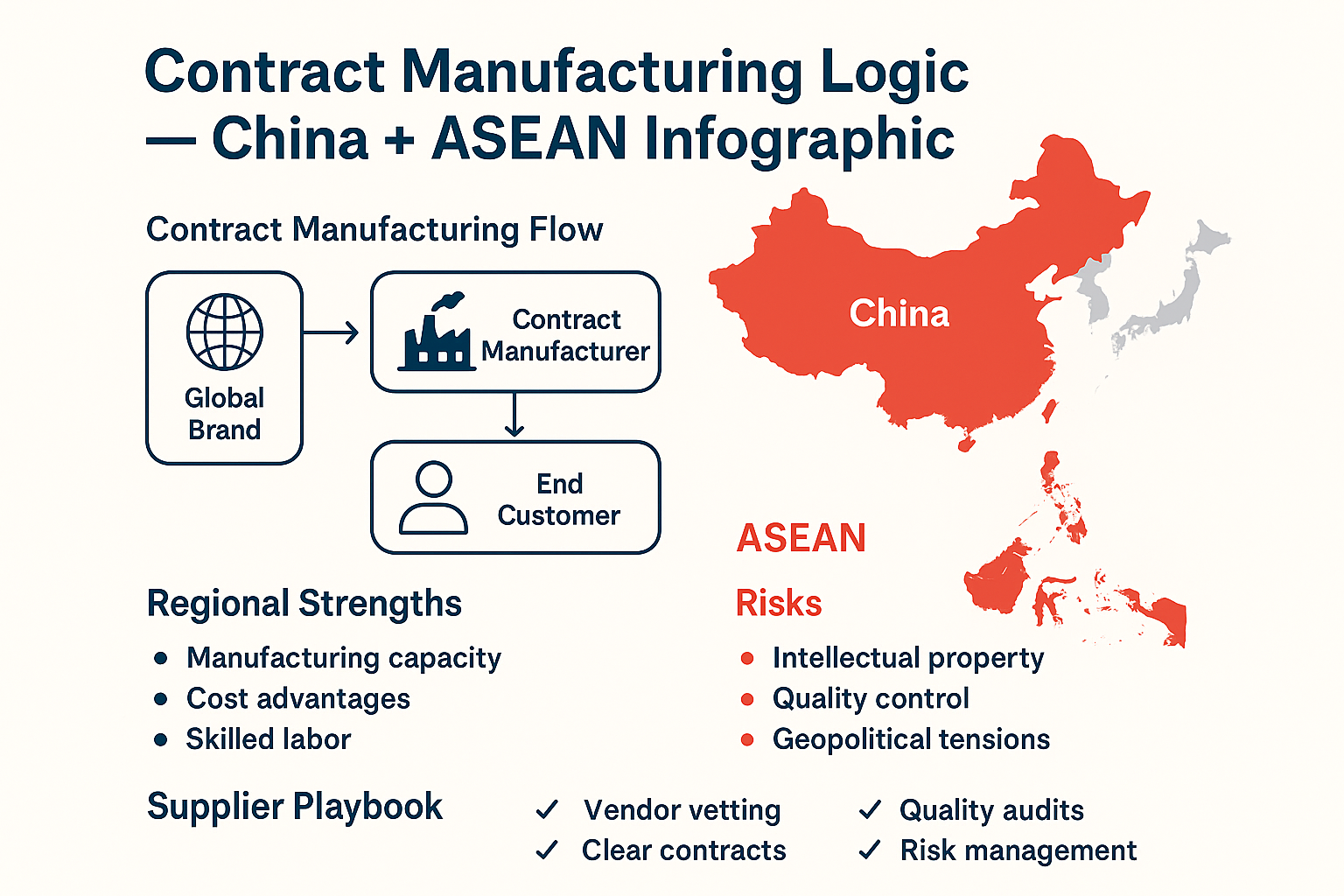
The Trump Administration’s 2025 tariff program has raised the stakes for global supply chains, but it also accelerates trends that benefit China and Southeast Asia (ASEAN) as complementary contract-manufacturing hubs. Short term it produces disruption and “front-loading” of shipments; medium-term it forces buyers and suppliers to rethink footprints and build resilient, higher-value regional supply chains. Smart manufacturers and service providers can respond with reshoring/nearshoring mixes, tariff engineering, localized value add, deeper services (design, testing, logistics), and by using regional trade networks to shift risk — turning uncertainty into market share and higher margins. (The White House, San Francisco Chronicle, Reuters)
1) The new policy reality (what changed)
In 2025 the U.S. introduced sweeping reciprocal tariffs and a blanket import duty that materially raised the cost of many imports. Firms reacted immediately: some rushed shipments into the U.S. to beat tariff effective dates, while others paused or rerouted flows to reassess costs and contracts. Macroeconomic models show these measures will reduce U.S. growth and raise consumer prices, while creating major, rapid demand-side shocks for global exporters. (The White House, San Francisco Chronicle, The Budget Lab at Yale)
Why this matters for contract manufacturing: tariffs change landed costs, which alters sourcing calculus overnight. But tariffs do not erase comparative advantages — they reprice them and open space for new commercial strategies.
2) A double-edged shock — risks and quick wins
Risks:
- Higher landed costs for exporters to the U.S. shrink margins and can depress volumes.
- Short-term uncertainty complicates inventory planning, capacity utilization, and financing.
- Some product categories (textiles, consumer electronics components) are particularly exposed.
Quick wins and resilience levers (opportunities):
- Front-running and reorder cycles create temporary demand spikes — manufacturers who can scale quickly and offer flexible production slots capture orders emptied from strained competitors. (Observed in U.S. ports’ surge prior to tariff dates.) (San Francisco Chronicle)
- Tariff arbitrage / product re-routing: using bonded warehouses, transshipment strategies, and tariff classification optimization to limit immediate tariff pain while longer-term footprint moves are planned.
- Value-added localization: adding final assembly, customization, or packaging in a lower-tariff jurisdiction reduces the tariff-exposed share of the product value chain.
3) Why China + ASEAN remain central — complementary strengths
China and Southeast Asia are not binary rivals — they are complementary nodes of a diversified manufacturing ecosystem.
China — upgraded, integrated, and still huge:
- China continues to invest in automation, R&D, and high-value manufacturing (advanced components, precision machining, electronics) making it the preferred partner for complex assemblies and supply ecosystem depth. Even when tariffs hit, buyers still rely on China for speed-to-scale, vertical supplier networks, and engineering talent.
ASEAN — a rising low-cost and agile alternative:
- Countries like Vietnam, Thailand, Malaysia, Indonesia, Cambodia, and the Philippines offer attractive labor costs, tax incentives, and improving infrastructure. China has also been actively investing in ASEAN manufacturing FDI, and that flow has grown — creating clusters with Chinese capital and know-how embedded locally. These cross-investments accelerate capability transfer and make ASEAN an efficient diversification destination. (Rhodium Group)
Policy buffer: in many cases the U.S. applied lower reciprocal tariffs to major ASEAN suppliers than to China, which cushions the region from the full brunt of tariff shocks and makes Southeast Asia more attractive for export-oriented production. (Reuters)
4) Practical strategies for contract manufacturers (what to do now)
Here are concrete, tactical moves manufacturers and their customers can take — framed to be optimistic and actionable.
Short term (0–6 months)
- Triage orders & prioritize high-margin SKUs. Push production of SKU families that tolerate tariffs (higher margin, brand premium, or low price elasticity).
- Use logistics levers: bonded zones, free trade zones, and strategic inventory pre-positioning can shave the immediate tariff hit. (Work with customs brokers to explore tariff classification reviews.)
- Accelerate lead-time reliability: provide guaranteed slots, expedited tooling and sample turns — buyers will pay for certainty when tariffs add cost.
- Flexible contracts & price clauses: add transparent tariff passthrough or sharing clauses with buyers to avoid margin erosion.
Medium term (6–24 months)
- Build “China+1” footprints intelligently: keep core, high-complexity production in China and move volume-sensitive, assembly-heavy or labor-intensive tasks to ASEAN. This keeps engineering close while pricing exposure falls.
- Upgrade local value-add in ASEAN: invest in testing, packaging, final assembly, and minimal customization in market-friendly jurisdictions to satisfy rules-of-origin or reduce tariff exposure.
- Tariff engineering & product redesign: small design changes (assembly sequence, inputs sourcing) can materially change tariff treatment. Combine this with supplier reshuffling so the tariff-exposed percentage of product value drops.
- Customer co-investment: secure long-term offtake or capex co-funding from western buyers who prefer diversified supply chains — this reduces capital friction for moving capacity.
Long term (24+ months)
- Climb the value chain in ASEAN: partner with local universities, vocational programs, and Chinese engineering centers to develop automation and quality systems — higher productivity reduces the wage premium and makes ASEAN competitive even with rising wages.
- Regional hubs & shared services: centralize testing, certification, and design services across ASEAN to serve multi-country clusters efficiently.
- Digital supply-chain twins & scenario planning: invest in real-time data tools so tariffs, transit times, and cost shocks are modeled quickly and decisions are evidence-based.
5) How buyers (brands & OEMs) should think about procurement
- Adopt category-specific sourcing playbooks. Not every part should be moved. Critical tech or IP-sensitive parts often remain in China; simpler assemblies move.
- Segment suppliers by risk appetite and strategic value: keep a core of high-quality China suppliers and an expandable second tier in ASEAN.
- Use total landed cost models, not just unit price. Include duties, inventory carrying cost, working capital, and lead-time penalties. The new tariff regime makes total-cost modeling essential.
- Invest in supplier development in ASEAN. Buyers who help suppliers upgrade capture preferential access and faster time-to-market.
6) What governments and industry bodies can do (policy & ecosystem)
- Improve one-stop trade facilitation (single windows, fast customs) — speed is a tariff offset.
- Offer targeted capex and skills subsidies to speed automation adoption and quality certification in ASEAN.
- Negotiate or clarify RCEP/CPTPP utilization and rules of origin to maximize tariff relief where applicable. (Many ASEAN members are RCEP parties; careful ROO planning reduces duty exposure.)
- Promote public-private supplier finance programs so SMEs can invest in capital equipment to win reallocated orders.
7) Realistic scenarios (how this plays out)
- Scenario A — “Balanced Diversification”: Major OEMs adopt China + Vietnam/Thailand strategies. China retains high-value work and R&D; ASEAN captures high-volume assembly. This reduces U.S. tariff exposure and preserves delivery speed. (This is analogous to observed FDI flows into ASEAN.) (Rhodium Group)
- Scenario B — “Tariff-Driven Squeeze”: Costs pass to consumers and volume falls in some categories; agile manufacturers who offered quick capacity growth capture market share in ASEAN and gain longer-term contracts. (Short-term port surges and front-loading are evidence of rapid commercial reaction.) (San Francisco Chronicle)
8) A positive takeaway — tariffs accelerate healthy, profitable evolution
Tariffs are painful, but they accelerate decisions companies were already postponing: diversifying supply, upgrading factories, and thinking in total landed cost instead of unit price. For capable contract manufacturers in China and ASEAN, this is an inflection point — suppliers that invest in operational flexibility, higher value-add, and customer partnerships will win larger, stickier contracts. Regions win too: ASEAN benefits from new FDI and technology transfer, while China upgrades into higher-value niches. Together they form a more resilient, diversified Asia manufacturing network attractive to global buyers.
9) Quick checklist for executives (5 action items)
- Run a SKU landed-cost analysis including new tariffs (next 30 days).
- Identify two ASEAN partners with capacity and quality credentials to pilot “assembly shift” (next 60 days).
- Negotiate bonded-warehouse or FTZ arrangements to phase exposure (next 90 days).
- Start capex conversations with strategic customers to co-fund automation/localization (next 6 months).
- Build an R&D / design-for-tariff team to find low-cost product tweaks that change tariff treatment (ongoing).
Closing (optimistic but honest)
Tariffs rewrite the arithmetic, but they do not eliminate competitive advantage. The smart approach — one we’re already seeing in supplier behavior and FDI flows — is to treat this as a forcing function: accelerate diversification, raise the value proposition of manufacturing in China and ASEAN, and use policy, logistics, and product design to protect margins. Firms that act fast and invest in capabilities will not just survive this tariff era; they will emerge stronger, more resilient, and better positioned for a world where supply-chain agility is the competitive differentiator. (The White House, The Budget Lab at Yale, Reuters)
Sources & further reading (selected)
- White House Fact Sheet — U.S. tariff measures (April 2025). (The White House)
- Yale Budget Lab — State of U.S. Tariffs (Aug 7, 2025) — macro impact analysis. (The Budget Lab at Yale)
- Reuters — “Relief in Southeast Asia as Trump’s tariffs level playing field.” (Aug 2025). (Reuters)
- Rhodium Group — China’s manufacturing FDI into ASEAN and implications. (Rhodium Group)
- San Francisco Chronicle — Port import surges as firms front-load shipments. (San Francisco Chronicle)