

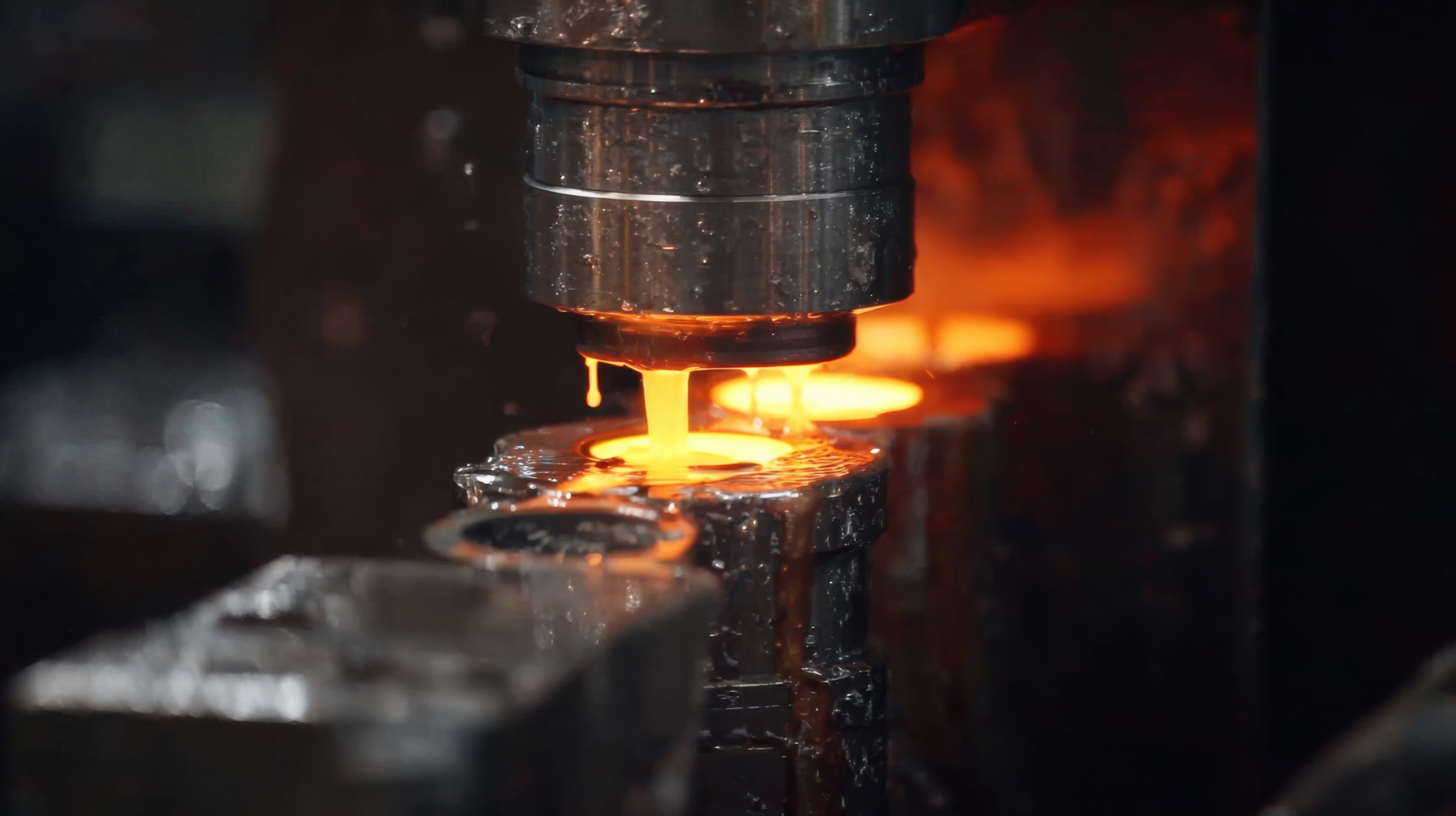
Industrial robots operate under extreme conditions—high cycle counts, heavy payloads, shock loads, and continuous torque—making component durability and fatigue resistance essential. Closed-die forging (also called impression-die forging) is widely recognized as the superior method for producing critical load-bearing parts such as gears, shafts, links, yokes, knuckles, and mounting flanges. As a specialist in precision metal forming, E-BI manufactures closed-die forged components in its facilities in China, Vietnam, and Thailand. This article outlines the principal advantages of closed-die forging for industrial robots and how E-BI helps robotics OEMs achieve longer service life and higher performance.
Superior Mechanical Properties Through Controlled Deformation
Closed-die forging compresses metal between two shaped dies, producing near-net-shape parts with exceptional grain flow and mechanical properties. Unlike machining from bar stock or casting, the forging process aligns grain structure along stress lines, significantly improving strength.
Key Advantages Compared to Other Methods
- Fatigue strength: 30–50% higher than machined or cast equivalents due to continuous grain flow and absence of porosity
- Tensile & yield strength: typically 20–40% higher than castings of the same alloy
- Impact toughness: dramatically improved — critical for shock-loaded joints and links
- Directional properties: grain flow follows the part contour, maximizing resistance to bending and torsional loads
- Surface integrity: work-hardened surface layer increases wear resistance on gear teeth and bearing journals
These improvements translate directly into longer mean time between failures (MTBF) and reduced warranty claims for high-cycle industrial robots Grand View Research.
Precision and Near-Net-Shape Capability
Modern closed-die forging achieves tolerances of ±0.3–0.8 mm on most dimensions, often requiring only minimal finish machining on bearing surfaces and gear teeth. This reduces material waste (30–60% savings vs machining from bar) and machining time, lowering overall cost per part.
Typical Robotic Components Produced by Closed-Die Forging
- Arm links, yokes, and knuckles
- Output shafts and pinions
- Gear blanks (spur, helical, bevel)
- Mounting flanges and base plates
- Crossheads and connecting rods in linear actuators
Multi-stage progression dies allow complex shapes with undercuts, thin webs, and deep recesses that would be impossible or uneconomical to machine Jabil.
E-BI’s Closed-Die Forging Capabilities for Robotics
E-BI operates 1,000–2,500 ton mechanical and hydraulic presses with integrated trimming and coining stations, optimized for precision robotic components.
Forging & Alloy Range
We forge:
- Carbon & alloy steels (1045, 4140, 4340, 8620)
- Case-hardening grades (16MnCr5, 18CrNiMo7-6)
- Stainless & tool steels for corrosion-resistant applications
- Part weights from 0.2 kg to 25 kg
- Flashless & precision forging techniques for minimal machining allowance
Secondary Operations & Quality Assurance
Post-forging capabilities include:
- CNC machining & gear cutting
- Carburizing, carbonitriding, induction hardening
- Shot peening for fatigue improvement
- 100% magnetic particle & ultrasonic inspection
- Full metallurgical lab (grain flow analysis, hardness mapping)
Regional Manufacturing Advantages
China offers large-tonnage capacity and integrated heat treatment. Vietnam and Thailand provide cost-competitive finishing and assembly with short lead times to North American and European robotics OEMs IndustryWeek.
Challenges in Closed-Die Forging for Robotics
Key challenges include:
- Die wear from high-strength alloys
- Controlling grain flow in complex multi-directional parts
- Maintaining dimensional stability after heat treatment
- Achieving consistent mechanical properties at scale
- High initial tooling cost for low-to-medium volumes
E-BI overcomes these through carbide and high-speed steel dies, FEM die simulation, controlled heat treatment, and statistical process control Wiley.
Building Stronger, Longer-Lasting Robots with E-BI
Closed-die forging produces robotic components with unmatched fatigue strength, precision, and material efficiency—critical for high-duty-cycle industrial robots. E-BI’s forging and finishing expertise in China, Vietnam, and Thailand delivers the durable, accurate parts that robotics companies need for reliable, long-service-life transmissions and structures.
For robotics OEMs developing industrial arms, gantry systems, heavy-payload robots, or precision gearboxes, partnering with E-BI provides a strategic advantage. Our proven closed-die forging capabilities and regional strengths can help you achieve superior component performance and cost efficiency. Connect with E-BI today to forge stronger, more reliable robotic gears and structures.