

In the dynamic world of global manufacturing, businesses must strategically choose where to locate their production facilities to optimize costs and quality. For technical manufacturing companies like E-BI, with operations in China, Vietnam, and Thailand, understanding the competitive advantages of different manufacturing hubs is crucial. Two leading destinations—China and Mexico—stand out for their robust manufacturing ecosystems, each offering unique benefits and challenges. This article explores the four key drivers of manufacturing in China versus Mexico, focusing on cost and quality, to guide businesses toward informed decisions. By examining labor costs, logistics and supply chain efficiency, quality control and workforce expertise, and trade agreements and tariffs, we provide actionable insights to enhance your manufacturing strategy.
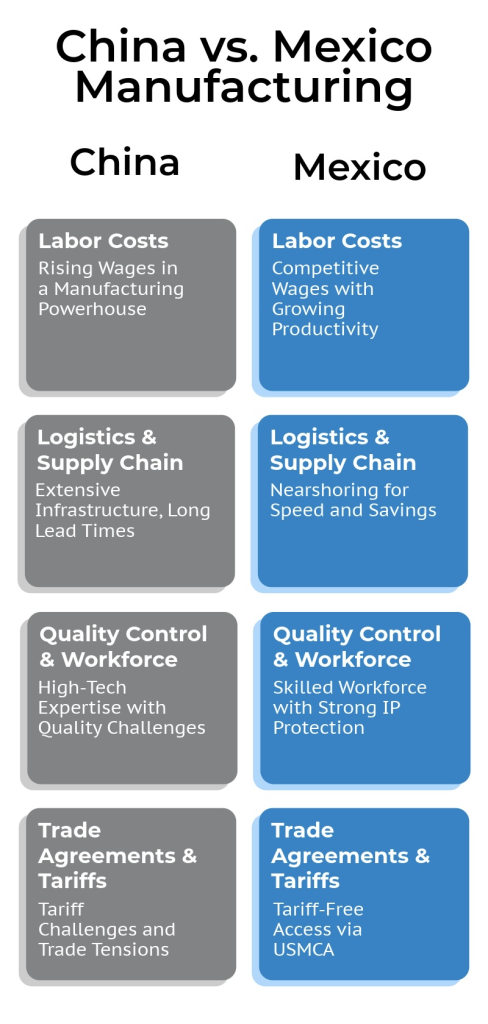
1. Labor Costs: Balancing Affordability and Productivity
Labor costs are a primary factor for manufacturers aiming to achieve cost-effective production. Both China and Mexico have historically attracted businesses with competitive wages, but recent trends reveal significant differences.
China: Rising Wages in a Manufacturing Powerhouse
China has long been the world’s manufacturing hub, driven by its vast workforce and economies of scale. However, labor costs have risen steadily. According to a 2023 analysis, the average manufacturing labor cost in China is approximately $6.50 per hour, including benefits, up from $1.63 per hour in 2011 (Tetakawi, NAPS). This increase stems from economic growth, improved living standards, and government policies promoting domestic consumption. In coastal regions, where most manufacturing is concentrated, wages can be even higher due to demand for skilled labor.
Despite higher wages, China’s productivity often offsets costs. The country’s advanced infrastructure and extensive supply chains enable high output per worker, particularly in industries like electronics and textiles (Visigistics). However, for companies prioritizing cost reduction, rising wages can challenge budgets, especially for labor-intensive products.
Mexico: Competitive Wages with Growing Productivity
Mexico offers lower labor costs, with an average manufacturing wage of around $4.50 per hour in 2023, down from $4.82 in 2020 (Novalink, NAPS). In regions like Tijuana and Monterrey, wages for skilled operators range from $4.13 to $5.31 per hour, depending on expertise (NAPS). Mexico’s proximity to the U.S. and lower cost of living contribute to these competitive rates.
Mexico has also enhanced productivity through investments in education and vocational training. Programs like the Advanced Technology Training Center (CEFTA) in Sonora improve workforce skills, particularly in automotive, aerospace, and electronics manufacturing (Tetakawi). While Mexico’s productivity may not yet match China’s in some high-tech sectors, the gap is closing, making Mexico a cost-effective option for labor-intensive manufacturing.
Cost Comparison
- China: Higher labor costs ($6.50/hour) but superior productivity in high-tech industries.
- Mexico: Lower labor costs ($4.50/hour) with improving productivity, ideal for cost-sensitive production.
For businesses like E-BI, Mexico’s lower wages offer significant savings, while China’s productivity advantages suit high-volume, complex manufacturing. The choice depends on your product’s labor intensity and quality requirements.
2. Logistics and Supply Chain Efficiency: Proximity vs. Scale
Logistics and supply chain efficiency are critical drivers of manufacturing costs and delivery timelines. The geographical and infrastructural differences between China and Mexico significantly impact these factors.
China: Extensive Infrastructure, Long Lead Times
China’s manufacturing ecosystem benefits from unparalleled infrastructure, including high-speed railways, modern ports, and a vast supplier network (Firstmold). This enables efficient production and access to raw materials, particularly for electronics and consumer goods. However, shipping from China to the U.S. incurs high costs and long lead times. Shipping a 40-foot container from China to the U.S. costs approximately $7,000–$8,378, with transit times of three weeks or more (Visigistics, NAPS). Recent disruptions, such as the 2024 Middle East conflict and Panama Canal drought, have further increased ocean freight rates and delays (TACNA).
Quality issues in China can also complicate logistics. Resolving defects often involves costly rework or returns due to distance and communication barriers, leading to write-offs (NAPS). For businesses targeting North American markets, these factors can erode cost savings.
Mexico: Nearshoring for Speed and Savings
Mexico’s proximity to the U.S. provides a significant logistical advantage, particularly for companies practicing nearshoring. Shipping from Mexico to the U.S. is faster and cheaper, with truckload costs ranging from $350 for Tijuana to San Diego to $2,800–$9,000 for longer routes like Monterrey to Dallas or Guadalajara to New York (TACNA). Transit times are typically 1–4 days, compared to weeks for China (Novalink, NAPS). This reduces inventory carrying costs and enables faster responses to market demand shifts.
Mexico’s participation in the USMCA (United States-Mexico-Canada Agreement) lowers logistics costs by providing tariff-free access to U.S. and Canadian markets for qualifying goods (Novalink). The IMMEX program allows duty-free imports of raw materials for export-bound products, enhancing cost efficiency (NAPS, IVEMSA). Mexico’s shelter model, where foreign companies operate under established Mexican entities, streamlines administrative tasks and reduces setup times to 3–4 months (NAPS).
Logistics Comparison
- China: Robust infrastructure but high shipping costs and long lead times to North America.
- Mexico: Lower shipping costs, faster transit times, and trade incentives via USMCA and IMMEX.
For E-BI clients targeting North American markets, Mexico’s logistical advantages make it a compelling choice for reducing total landed costs and improving supply chain agility.
3. Quality Control and Workforce Expertise: Precision vs. Proximity
Quality control is paramount in technical manufacturing, where precision and reliability determine product success. Both China and Mexico have skilled workforces, but their approaches to quality and workforce training differ.
China: High-Tech Expertise with Quality Challenges
China’s workforce is renowned for its expertise in complex manufacturing, particularly in electronics, automotive, and consumer goods (Firstmold). The country’s focus on STEM education produces millions of engineers and technicians annually, supporting industries requiring high precision (Firstmold). Certifications like ISO 9001 and ISO 14001 are widely available, though certification processes can be slower due to regional regulatory differences (Firstmold).
However, quality issues persist in China, often due to distance and communication barriers. Defective products may not be identified until they reach the destination, leading to costly rework or scrapping (NAPS). Intellectual property (IP) concerns also pose risks, with counterfeiting and weak enforcement reported in some sectors (NAPS). Despite improvements in IP laws, China remains on the U.S. Trade Representative’s Priority Watch List.
Mexico: Skilled Workforce with Strong IP Protection
Mexico’s workforce is increasingly skilled, particularly in automotive, aerospace, and medical device manufacturing. The country graduates tens of thousands of engineers annually from institutions like Tecnológico de Monterrey and Universidad Nacional Autónoma de México, ranked among the top 150 globally (Tetakawi). Vocational training programs tailored to industry needs ensure workers meet stringent technical standards (Tetakawi).
Mexico excels in quality control due to its proximity to the U.S., allowing easier oversight and faster resolution of issues. Products can be returned for repair or replacement within days, and U.S. managers can visit facilities with minimal travel time (Visigistics). Mexico’s strong IP protection, aligned with USMCA regulations, provides greater security for proprietary designs compared to China (TACNA). Certifications like ISO 9001 are streamlined, and environmental standards enforced by agencies like SEMARNAT align with North American norms (Firstmold).
Quality Comparison
- China: High-tech expertise but challenges with quality control and IP protection.
- Mexico: Skilled workforce, easier quality oversight, and robust IP safeguards.
E-BI leverages its expertise in quality assurance to deliver precision manufacturing in both regions, but Mexico’s proximity and IP protections make it ideal for industries requiring stringent standards.
4. Trade Agreements and Tariffs: Navigating Global Markets
Trade policies and tariffs significantly influence manufacturing costs and market access. China and Mexico operate under different trade frameworks, affecting their competitiveness.
China: Tariff Challenges and Trade Tensions
China’s manufacturing benefits from tax incentives in Special Economic Zones (SEZs) and Free Trade Zones (FTZs), offering low corporate taxes and VAT exemptions (Firstmold). However, U.S.-China trade tensions have led to tariffs of up to 25% on Chinese imports, increasing costs for U.S.-bound goods (Novalink). These tariffs, combined with China’s managed currency policy, which limits Yuan appreciation, create uncertainty in wage growth and export pricing (TACNA).
China’s trade relationships with other countries can also complicate market access, as tariffs and restrictions vary widely (Visigistics). For companies exporting to North America, these factors can offset production cost advantages.
Mexico: Tariff-Free Access via USMCA
Mexico’s participation in the USMCA provides tariff-free access to U.S. and Canadian markets for goods meeting rules of origin, a significant advantage over China (Novalink). The IMMEX program reduces costs by allowing duty-free imports of raw materials for export products (IVEMSA). Mexico’s 12 multilateral trade agreements with 44 countries enhance its global market access, making it a hub for international trade (Visigistics).
Local incentives, such as tax breaks and investment subsidies, attract foreign manufacturers, particularly in aerospace, automotive, and electronics (Novalink). Mexico’s stable peso and predictable wages provide long-term cost certainty, unlike China’s volatile trade environment (TACNA).
Trade Comparison
- China: Tax incentives but high U.S. tariffs and trade uncertainties.
- Mexico: Tariff-free USMCA access, IMMEX benefits, and stable trade policies.
For E-BI clients, Mexico’s trade advantages translate to lower costs and faster market entry, particularly for North American customers.
Strategic Insights: Choosing the Right Manufacturing Partner
The comparison highlights that China excels in high-volume, high-tech manufacturing with robust infrastructure, but rising labor costs, long lead times, and trade tariffs pose challenges. Mexico, with lower labor costs, proximity to the U.S., strong IP protections, and favorable trade agreements, is increasingly competitive for cost-sensitive and quality-driven production.
For businesses evaluating manufacturing options, the decision depends on product type, target market, and strategic priorities:
- Choose China for high-volume electronics or textiles requiring extensive supply chains and economies of scale.
- Choose Mexico for automotive, aerospace, or medical device manufacturing targeting North America, where speed, quality, and cost savings are critical.
At E-BI, we understand the complexities of global manufacturing. With decades of experience in China, Vietnam, and Thailand, we offer tailored solutions to optimize your production strategy. Our expertise in technical manufacturing, combined with a commitment to quality and cost efficiency, positions us as your ideal partner for nearshoring to Mexico or scaling operations in Asia.
Partner with E-BI for Your Manufacturing Success
Don’t let the complexities of global manufacturing hinder your growth. Whether you’re exploring nearshoring to Mexico or leveraging Asia’s manufacturing strengths, E-BI is here to guide you. Our team specializes in delivering cost-effective, high-quality manufacturing solutions tailored to your needs. Contact us today to discuss how we can collaborate to streamline your supply chain, reduce costs, and deliver superior products to your customers.
Schedule a Consultation with E-BI
Sources
- NAPS: Manufacturing in Mexico vs. China
- Visigistics: Cost Analysis Mexico vs. China
- IVEMSA: Advantages of Manufacturing in Mexico
- Novalink: Is It Cheaper to Manufacture in Mexico?
- Tetakawi: Manufacturing Wages in Mexico vs. China
- Firstmold: Mexico vs. China Manufacturing
- TACNA: Mexico vs. China Manufacturing Comparisons