

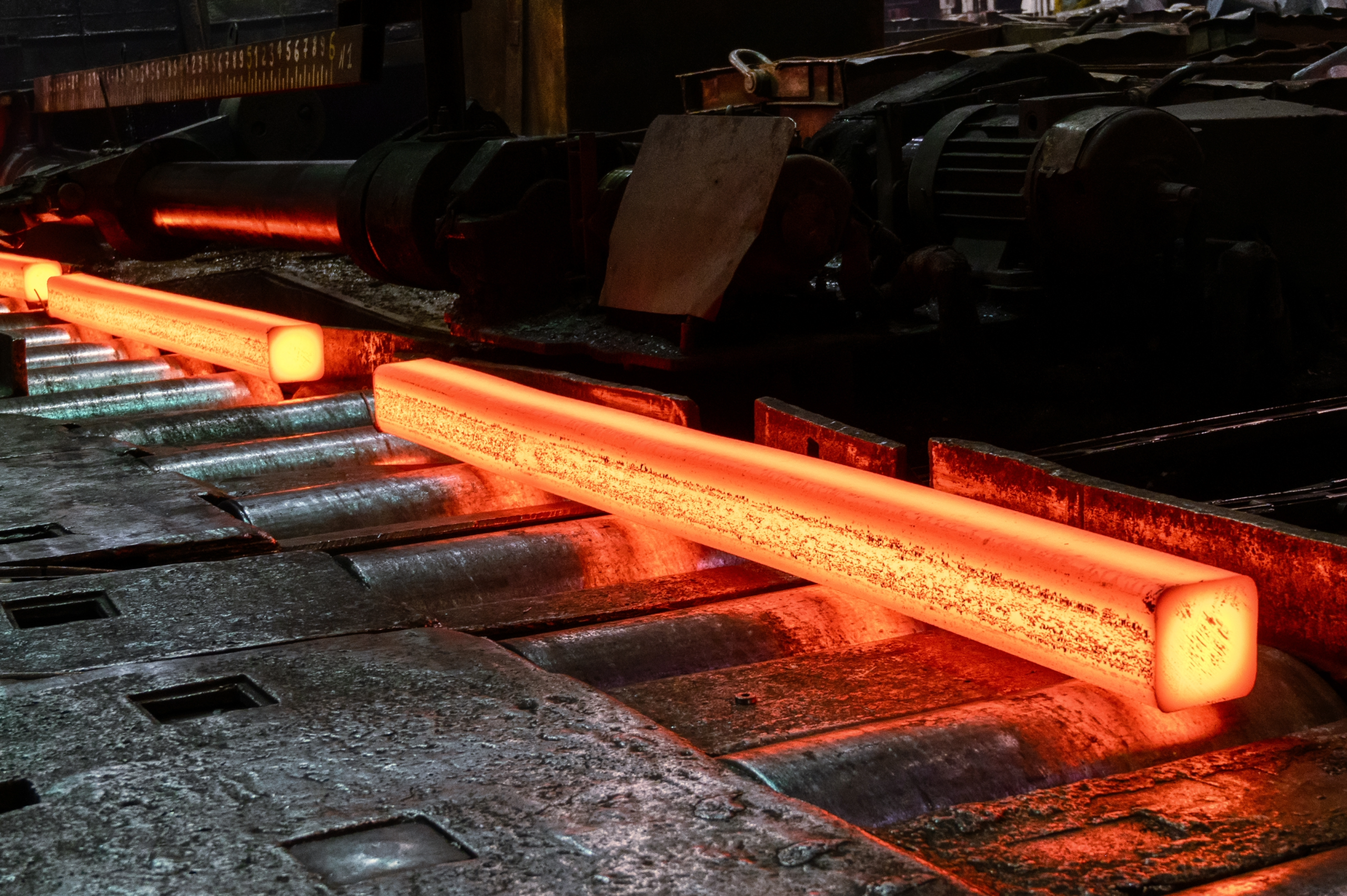
Robotic actuators that deliver high torque in compact packages (humanoid hips/ankles, industrial robot joints, high-force linear actuators) tend to fail in predictable places: shafts, yokes, clevises, gear hubs, and output interfaces. When those parts are fatigue-limited or see impact/shock loads, forging is often the most reliable way to raise strength and toughness without making the part bigger.
Forging is not a blanket upgrade. It’s best used for a subset of “high consequence” components where grain flow, toughness, and defect resistance matter more than geometric complexity.
Why forging helps actuator reliability
1) Grain flow aligned with the load path
In closed-die forging, the metal’s grain flow can be shaped to follow the part geometry, improving resistance to crack initiation and propagation compared to cut-from-billet parts where grain flow is uniform and gets interrupted by machining. (This is one reason forged crankshafts and connecting rods are so durable in engines.)
Forging process overview (background):
https://en.wikipedia.org/wiki/Forging
2) Better fatigue and impact performance than castings
Compared with cast parts, forgings generally have fewer internal voids and defects (casting porosity/shrinkage) and can deliver higher toughness. That matters in robots because falls and hard stops create shock loading.
Casting defect background (porosity context):
https://en.wikipedia.org/wiki/Porosity
3) Lighter for the same durability (in the right parts)
If a joint is currently “surviving” via overbuilt section thickness, a forged alloy steel part can often be reduced in size while meeting the same fatigue/impact requirement—especially for shafts and yokes where the load path is well defined.
Where forgings make the most sense in robotic actuators
These are the highest ROI “forged candidates” in high-load joints:
- Output shafts and stubs (especially with shoulders, splines, or flange interfaces)
- Yokes / clevises / forks (hip/ankle link yokes, rod-end interfaces)
- Eccentrics and cams (high contact stresses, cyclic loads)
- Gear hubs / carriers (planet carriers, ring gear supports)
- Bearing journals and seats (where toughness matters during press-fit and impact)
- High-load link ends (lug features, thin ear tabs, compact geometry)
Usually not the best forging targets:
- Thin covers and housings (sheet metal / die cast / machined aluminum often wins)
- Complex internal fluid passages (casting/additive may be better)
- Features dominated by tight GD&T across many faces (you’ll still machine them)
Forging process options for actuator parts
Closed-die forging
Best for: yokes, shafts with shoulders, near-net external shapes
Why: highest opportunity to align grain flow and produce near-net geometry for machining.
Closed-die forging background:
https://en.wikipedia.org/wiki/Impression_die_forging
Open-die forging
Best for: large shafts, thick rings, simple preforms, low-to-mid volume heavy sections
Often used as a “starting shape” before machining.
Open-die forging background:
https://en.wikipedia.org/wiki/Open-die_forging
Ring rolling
Best for: bearing-like rings, large actuator rings, ring gears (as blanks)
Good for high-integrity rings with efficient material usage.
Ring rolling background:
https://en.wikipedia.org/wiki/Ring_rolling
Forging vs CNC billet vs casting for actuator components
Choose forging when:
- The part is fatigue or impact limited
- Failures initiate at fillets, keyways, splines, or shoulders
- You need higher toughness than a cast part can reliably provide
- You want to reduce weight without increasing failure risk
- You plan to machine critical interfaces after forging
Choose CNC from billet when:
- Quantity is low and the design is still moving
- Geometry is complex and doesn’t suit forging (or forging tooling isn’t justified)
- You need fast iteration and can accept the material waste
Choose casting when:
- The geometry is complex and thin-wall (housings, covers, brackets)
- Cost per part at volume is the main driver
- You can post-machine critical features and you’ve mitigated porosity risks
Material selection for forged actuator components
Below is the practical “robotics short list.” (Most forged parts still get post-machined and heat treated—material choice and heat treat are inseparable.)
4140 / 4142 (chromoly) — the default
Best for: shafts, pins, yokes, hubs
Why: strong, tough, widely forgeable, widely heat treatable, good cost/availability
4140 background:
https://en.wikipedia.org/wiki/SAE_4140_steel
4340 — for higher toughness and shock
Best for: output shafts and yokes with severe impact or high fatigue demand
Why: higher hardenability and toughness than many general steels
4340 background:
https://en.wikipedia.org/wiki/SAE_4340
17-4 PH stainless — strength + corrosion resistance
Best for: exposed actuator hardware in sweat/humidity environments; parts where rust/seizure risk drives service cost
Why: precipitation-hardening stainless with good strength and decent machinability
17-4 PH background:
https://en.wikipedia.org/wiki/17-4_stainless_steel
Titanium (Grade 5 / Ti-6Al-4V) — selective use
Best for: compact, geometry-limited parts where corrosion and strength-to-weight matter and you accept machining cost
Why: strong, corrosion resistant; but not a gear/bearing steel and not a stiffness fix
Ti-6Al-4V background:
https://en.wikipedia.org/wiki/Ti-6Al-4V
Heat treat and surface engineering (where actuator performance is won)
Through hardening and tempering (Q&T)
Common for 4140/4340 forgings. Lets you balance strength and toughness.
Quenching and tempering background:
https://en.wikipedia.org/wiki/Tempering_(metallurgy)
Case hardening (when wear dominates)
For splines, gear interfaces, and high wear areas, many designs rely on a hard case + tough core approach (carburizing or similar methods) rather than trying to make the whole part “hard.”
Case hardening background:
https://en.wikipedia.org/wiki/Case-hardening
Nitriding / ferritic nitrocarburizing (great for shafts/pins)
Good for wear and fretting resistance with relatively low distortion—useful when you need stable bearing fits.
Nitriding background:
https://en.wikipedia.org/wiki/Nitriding
Design rules for forged actuator parts
1) Design the forging first, then the machining
A forged component is usually near-net, not net. Plan:
- machining stock on critical faces
- how the part will be fixtured (datum pads, centers)
- how flash lines and parting lines avoid critical surfaces
2) Use radii generously
Forging likes radii; fatigue likes radii. Tight internal corners increase:
- die stress and wear
- split risk in forging
- stress concentration in service
3) Avoid thin “knife edges”
Thin webs and sharp transitions are crack starters and can be hard to fill consistently.
4) Put grain flow where it matters
Ask your forge supplier to propose a preform so that grain flow wraps around:
- yoke arms
- lug features
- shaft shoulders
5) Expect post-machining on:
- bearing seats and journals
- splines and keyways
- sealing faces
- gear mounting faces
- precision threads
Tolerances and quality realities
Forging tolerances
Forged parts typically have looser as-forged tolerances than machined parts, especially on:
- flash-related surfaces
- draft angles
- parting line mismatch
That’s normal—you machine the interfaces that matter.
Defect risks to control
- laps/folds from improper fill
- decarb on surfaces (affects fatigue)
- distortion from heat treat
- surface scale impacting fits
A good control plan includes:
- defined NDT requirements (when needed)
- hardness and microstructure verification
- dimensional checks after heat treat
- controlled machining datum strategy
Non-destructive testing background:
https://en.wikipedia.org/wiki/Non-destructive_testing
A typical “forged actuator component” process chain
- Forge preform (closed-die or open-die)
- Trim / blast / normalize (as required)
- Heat treat (Q&T, solution/age for PH stainless, etc.)
- Rough machining (establish datums)
- Finish machining (bearing fits, splines, threads)
- Surface treatment (nitriding/coating as required)
- Final inspection (CMM + hardness + NDT if specified)
Validation and test strategy for robotics
For high-load joints, material/process changes should be validated with tests that match real failures:
- Torque cycling with realistic duty cycles (including reversals)
- Shock / drop / hard-stop events (peak loads)
- Thermal cycling if near motors/gearboxes
- Fretting tests at clamped interfaces (splines, couplers)
- Corrosion exposure if sweat/humidity is real (especially mixed metals)
RFQ checklist for forged robotic actuator parts
- Part function: output shaft / yoke / hub / carrier / pin
- Target volume: prototype, pilot, annual
- Forging process: closed-die / open-die / ring rolled (or “supplier recommend”)
- Material + spec: 4140 / 4340 / 17-4 PH / Ti-6Al-4V (include condition/temper if known)
- Heat treat requirement: strength/hardness range (HRC), toughness targets if available
- Surface treatment: nitriding / nitrocarburizing / coating / none
- Critical machined features: bearing fits, spline class, thread class, sealing faces
- Critical GD&T: coaxiality, runout, true position, flatness
- Quality requirements: hardness certs, microstructure, decarb limits, NDT (MPI/UT) if required
- Traceability: heat/lot trace and material certs
- Inspection: CMM report for interfaces, gage strategy for volume
- Packaging: protect journals/splines from nicks; rust inhibitor if not stainless
Outbound references used in this guide
Forging (general): https://en.wikipedia.org/wiki/Forging
Closed-die forging: https://en.wikipedia.org/wiki/Impression_die_forging
Open-die forging: https://en.wikipedia.org/wiki/Open-die_forging
Ring rolling: https://en.wikipedia.org/wiki/Ring_rolling
4140 steel: https://en.wikipedia.org/wiki/SAE_4140_steel
4340 steel: https://en.wikipedia.org/wiki/SAE_4340
17-4 PH stainless: https://en.wikipedia.org/wiki/17-4_stainless_steel
Ti-6Al-4V: https://en.wikipedia.org/wiki/Ti-6Al-4V
Case hardening: https://en.wikipedia.org/wiki/Case-hardening
Nitriding: https://en.wikipedia.org/wiki/Nitriding
Non-destructive testing: https://en.wikipedia.org/wiki/Non-destructive_testing
Porosity (casting defect concept): https://en.wikipedia.org/wiki/Porosity
Takeaways
- Forging is most valuable for shafts, yokes, hubs, and carriers that are fatigue/impact limited in high-load actuator joints.
- Treat forgings as near-net blanks: forge for integrity and grain flow, then machine critical interfaces.
- The real performance lever is material + heat treat + surface engineering, not forging alone.