

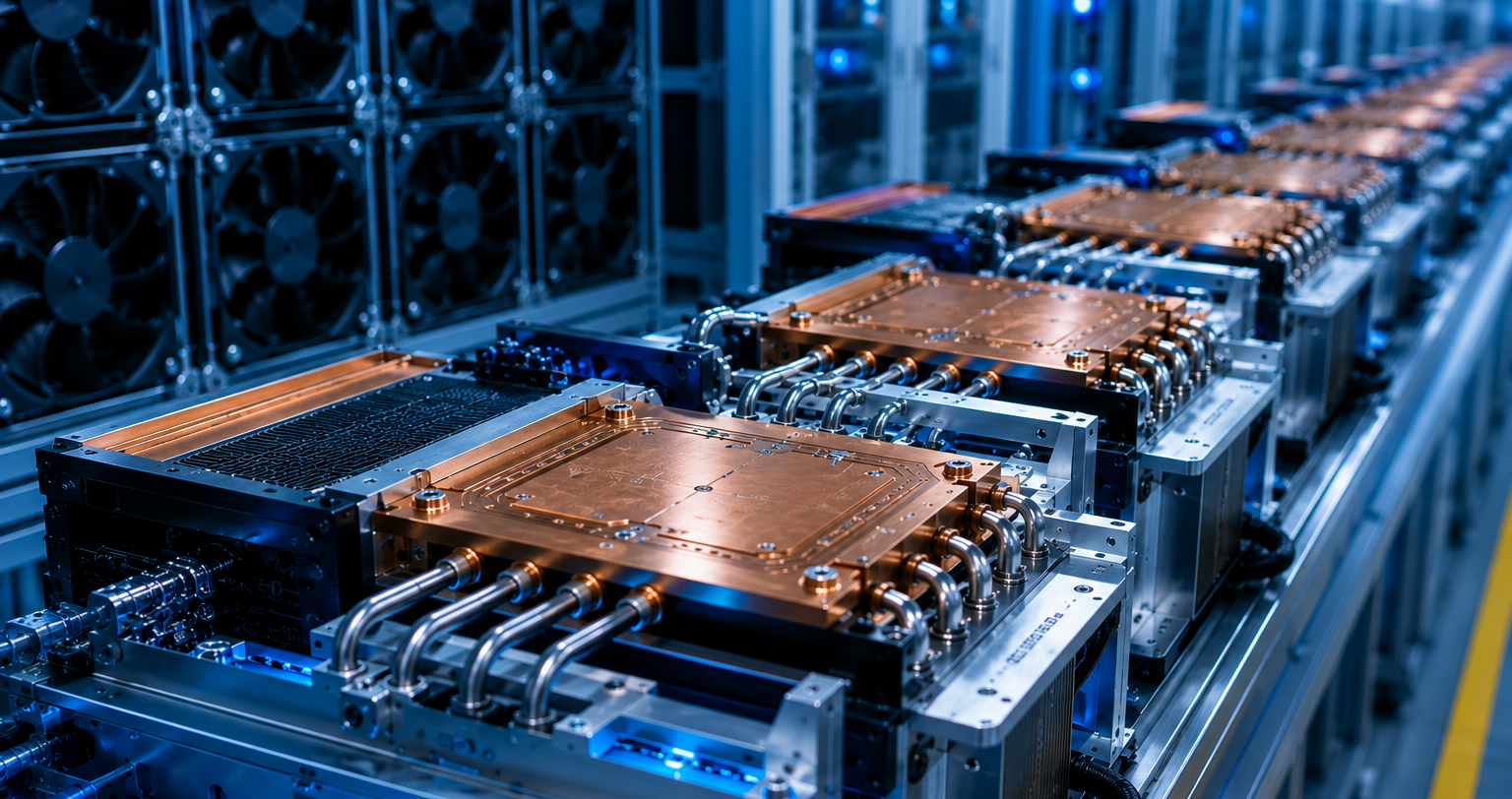
Artificial intelligence is changing more than the computing power inside data centers. It is also changing how that computing power must be cooled.
As AI servers become more power-dense, traditional air-cooling systems are nearing their practical limits. NVIDIA notes that data-center racks that historically operated around 20 kW can now exceed 135 kW in hyperscale environments. Lawrence Berkeley National Laboratory estimates that U.S. data centers could account for about 11.8% of U.S. electricity consumption by 2030.
These trends are accelerating demand for direct-to-chip liquid cooling, coolant distribution units, cold plates, manifolds, heat exchangers and hybrid thermal-management systems. For companies developing this equipment, however, the challenge is not only designing a system that removes heat effectively. It is manufacturing that system reliably, repeatedly, and at scale.
Why Liquid Cooling Is Growing
Air cooling will remain important in data centers, but higher rack densities are increasing the appeal of liquid cooling because liquid can move heat efficiently and can be brought much closer to heat-generating components.
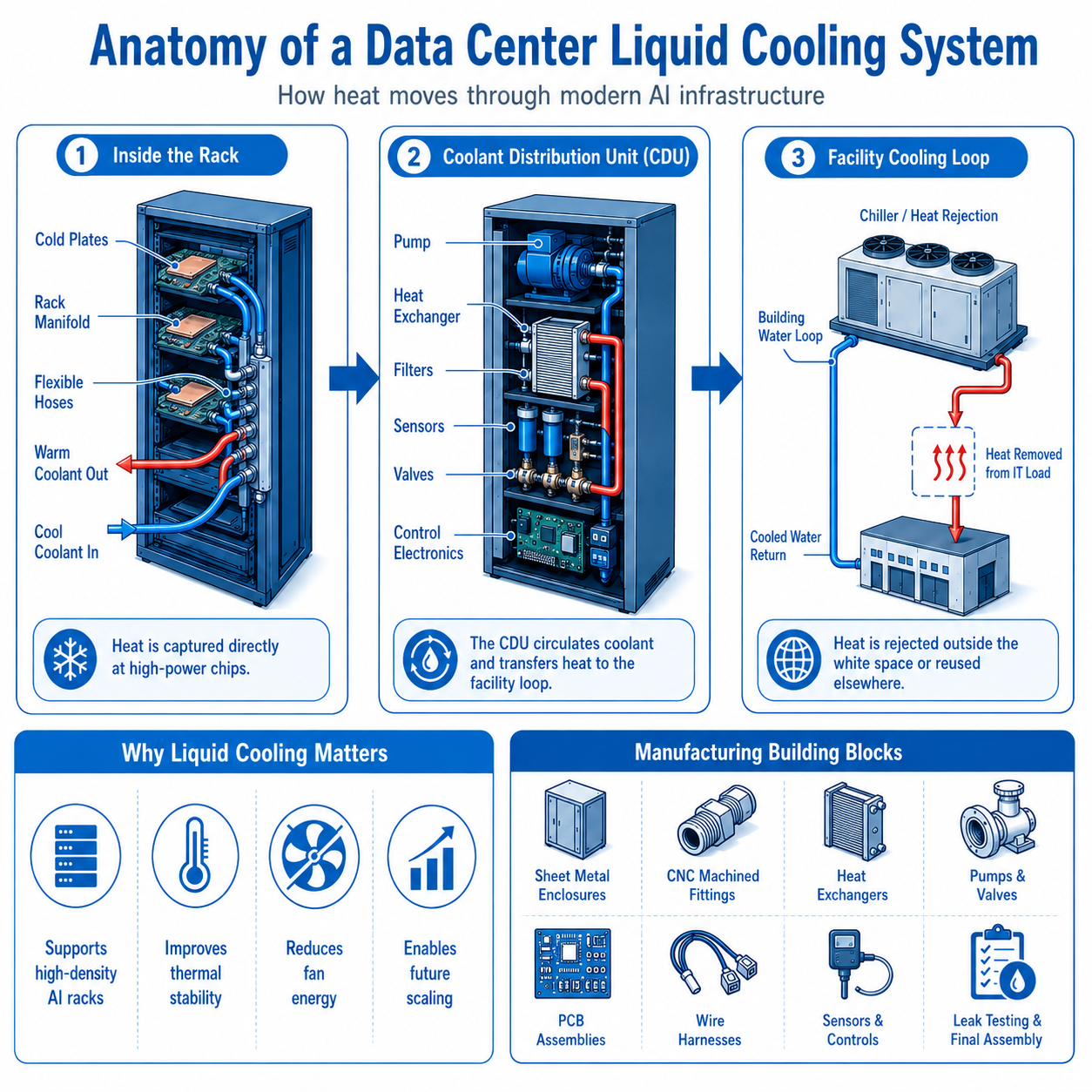
In a direct-to-chip system, coolant flows through cold plates attached to processors and other high-heat electronics. The warmed coolant then moves through the rack and into a coolant distribution unit, or CDU, which transfers heat into the facility cooling loop.
The shift is already visible in next-generation infrastructure. NVIDIA’s Blackwell platform uses liquid cooling to address the heat generated by high-density AI racks. The Open Compute Project is also developing requirements, specifications, and best practices covering cold plates, tubing, manifolds, quick disconnects, and CDUs.
From a manufacturing perspective, that matters because liquid cooling is not a single component. It is an interconnected mechanical, electrical, and fluid-handling system.
What Goes Into a Liquid-Cooling System?
Coolant Distribution Units
A CDU may combine pumps, heat exchangers, valves, sensors, control electronics, PCB assemblies, wire harnesses, tubing, manifolds, machined fittings, and sheet-metal enclosures. Each part must function correctly on its own while also integrating into the larger thermal system.
As capacities rise, manufacturers must control pressure, flow, leak prevention, material compatibility, and long-term reliability. The challenge is therefore not simply fabricating parts. It is producing an integrated system with repeatable performance. The Open Compute Project has also published liquid-to-liquid CDU design and testing guidance, reflecting the growing need for consistent performance as these systems scale.
Cold Plates and Fluid Components
Cold plates sit directly against high-heat electronics and transfer that heat into circulating coolant. Their performance can depend on internal geometry, materials, flatness, machining quality, joining methods, and surface consistency.
Small manufacturing variations can matter. A poorly controlled sealing surface can create a leak risk. Inconsistent internal channels can affect pressure drop or flow distribution. The surrounding loop adds hoses, quick-disconnect fittings, manifolds, and seals that must perform reliably together.
That is why supplier quality matters so much. An excellent thermal design can still run into production problems if one supplier cannot consistently hold tolerances, maintain cleanliness, or meet growing volume requirements.
Design Decisions Affect Manufacturability
Material Compatibility and Leak Integrity
Liquid-cooling systems can bring metals, elastomers, coatings, seals and coolant chemistries into the same loop. Engineers must consider corrosion, seal durability, and long-term material compatibility when choosing components and finishes.
Geometry matters too. Cold plates and manifolds may require close control of flatness, channels, threads, sealing surfaces and joint integrity. NVIDIA rack documentation emphasizes leak detection as important for protecting equipment and maintaining reliability and uptime.
Design for Assembly and Service
Manufacturing should also influence how a cooling product is assembled and serviced. Tubing and harness routing, fastener selection, part count and modular subassemblies can all affect assembly time and repeatability.
Design-for-manufacturing reviews can identify these issues before volume production. A prototype may prove that the thermal concept works; DFM helps determine whether the product can be built consistently and economically.
From Prototype to Repeatable Production
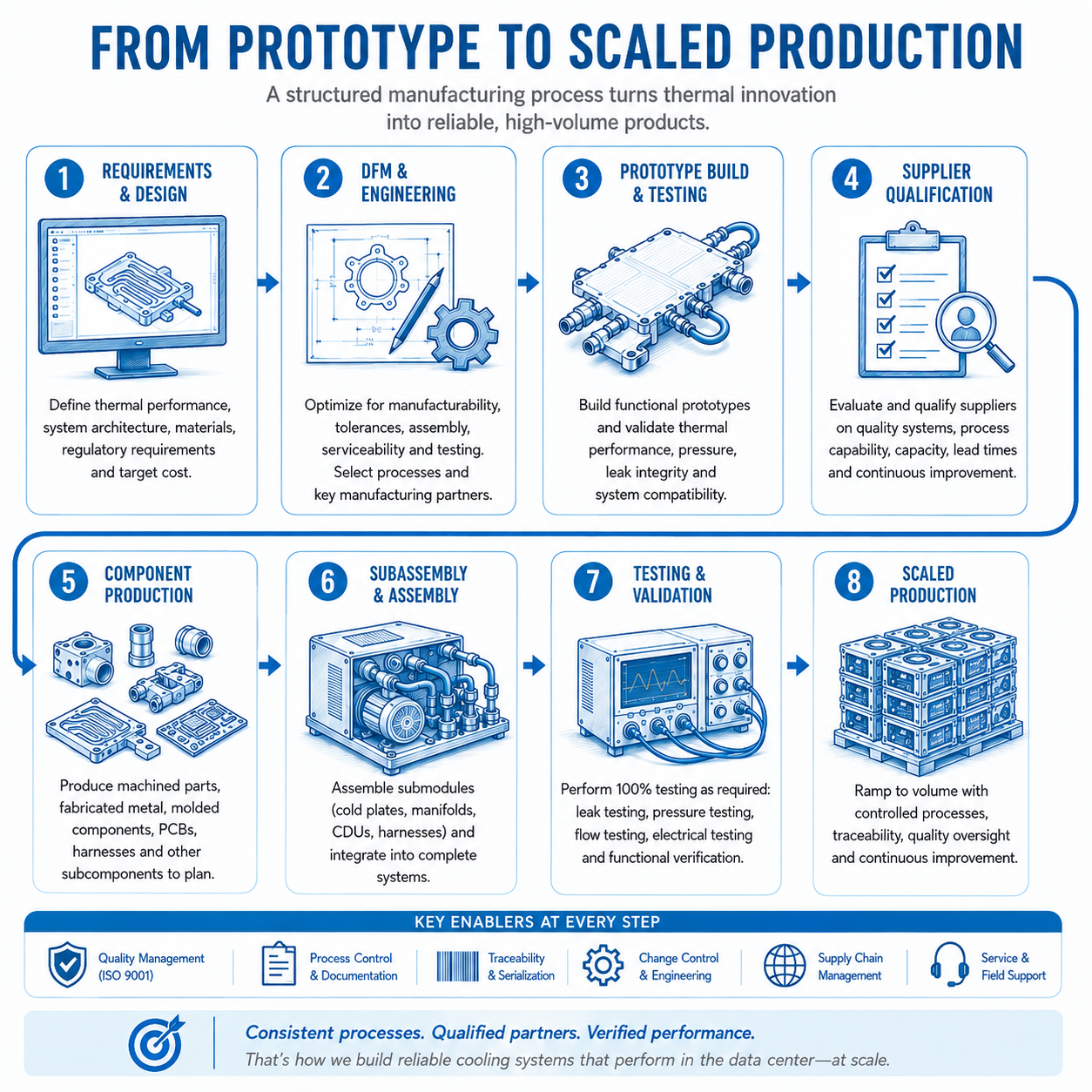
Producing a working prototype is very different from producing hundreds or thousands of reliable systems. Prototype parts are often optimized for speed, while production requires attention to tooling, tolerance strategy, component availability, assembly time, testing, and yield.
Supplier qualification becomes equally important. Cooling products may use separate suppliers for machined parts, fabricated metal, electronics, wiring, molded components, and fluid-handling hardware. A supplier that can produce a few samples may not have the process control or capacity required for a larger program.
Testing also becomes part of manufacturing rather than simply final inspection. Depending on the product, production may involve pressure testing, leak testing, flow testing, dimensional inspection, electrical testing, and functional verification.
As volume grows, coordinating all of those suppliers can become a significant burden for engineering and operations teams. Time that could be spent developing the next generation of products can instead be consumed by quotations, quality issues, engineering changes, lead times, and logistics.
Scaling With AI Infrastructure
The pressure to solve these manufacturing challenges is likely to increase. The International Energy Agency projects that global data-center electricity consumption will more than double to around 945 TWh by 2030, with AI as the most important driver of that growth.
For cooling manufacturers, demand can change quickly when a new computing platform, customer deployment or data-center project enters production. Companies that wait until demand arrives to build supply-chain capacity may struggle to respond.
Qualified suppliers, second-source options, and scalable manufacturing processes can reduce that risk. The goal is to increase volume without sacrificing quality or creating a new bottleneck elsewhere in the system.
Manufacturing Support for Data Center Cooling Companies
The next generation of AI infrastructure will depend not only on better processors, but also on the physical hardware surrounding them.
E-BI International works with hardware manufacturers through a global network of manufacturing partners and support teams. Depending on product requirements, support can include CNC-machined components, sheet-metal fabrication, injection-molded components, PCB assemblies, wire and cable harnesses, mechanical and electromechanical subassemblies, product assembly, quality oversight and engineering support.
For companies using several of these processes, E-BI can provide a single point of accountability across manufacturing, sourcing, quality, and logistics rather than requiring engineering teams to coordinate every manufacturing resource independently.
As AI drives the next wave of data-center construction, cooling technology will continue evolving with it. Companies that combine innovative thermal designs with scalable, reliable manufacturing will be better positioned to meet that demand.
Developing data-center cooling or thermal-management hardware? Contact E-BI International to discuss how our manufacturing network can support your next product or production program.