

Sterilization is one of the most important considerations in medical device manufacturing. Whether producing a surgical instrument, implant, catheter, diagnostic component or single-use device, manufacturers must control contamination and demonstrate that the finished product can be sterilized safely and consistently.
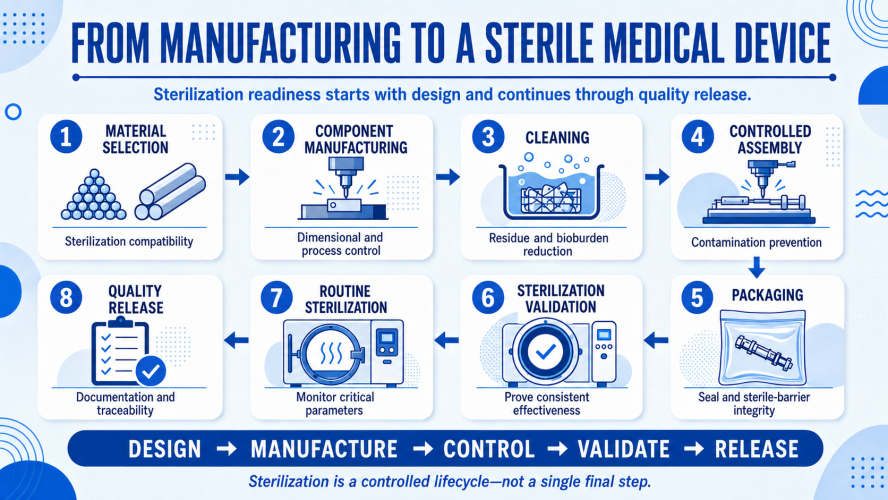
However, sterilization is not simply a final production step. The selected method can affect material selection, component design, electronics, adhesives, packaging, manufacturing processes and product shelf life. Medical device companies should therefore develop their sterilization strategy early—ideally during the design-for-manufacturing stage.
This guide explains the principal medical device sterilization methods, the standards governing them and how manufacturers can prepare products for successful sterilization validation.
What Is Medical Device Sterilization?
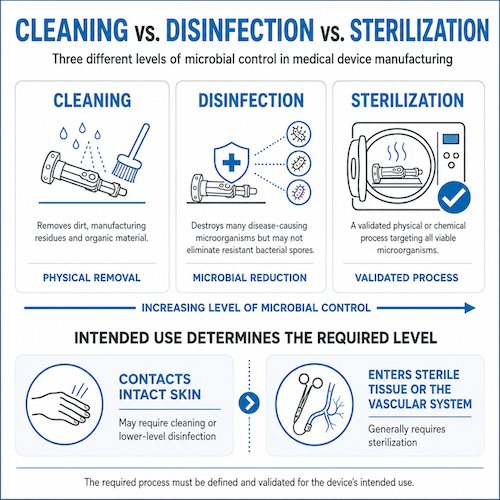
Sterilization is a validated process intended to render a product free from viable microorganisms. It differs from cleaning and disinfection:
- Cleaning removes dirt, manufacturing residues and organic material.
- Disinfection destroys many disease-causing microorganisms but may not eliminate resistant bacterial spores.
- Sterilization targets all viable microorganisms using a validated physical or chemical process.
The appropriate level of microbial control depends on the device’s intended use. Devices that enter sterile tissue or the vascular system generally require sterilization, while products that contact intact skin may only require cleaning or lower-level disinfection.
According to the U.S. Food and Drug Administration, medical devices may be sterilized using steam, dry heat, radiation, ethylene oxide, vaporized hydrogen peroxide and several other technologies.
Sterilization must be supported by objective evidence. Inspecting or testing a small number of finished devices cannot prove that every product in a production batch is sterile. Manufacturers must instead validate the complete process and control the critical parameters that produce the required result.
Medical Device Sterilization Methods

Steam Sterilization
Steam sterilization, frequently called autoclaving, uses saturated steam under pressure. It is widely used because it is effective, relatively fast and does not leave toxic chemical residues.
Steam is suitable for heat- and moisture-resistant products such as certain stainless-steel surgical instruments, reusable equipment and some glass or polymer components. However, its elevated temperature and moisture can deform thermoplastics, damage electronics, weaken adhesives or corrode sensitive metals.
ISO 17665:2024 establishes requirements for developing, validating and routinely controlling moist-heat sterilization processes. Manufacturers considering steam sterilization must evaluate the temperature resistance of every material, coating, seal and assembled component.
Ethylene Oxide Sterilization
Ethylene oxide, or EtO, is a low-temperature gas used extensively for heat- and moisture-sensitive medical devices. Because the gas can penetrate porous packaging and reach difficult internal areas, it is often used for catheters, tubing sets, electronic devices and products with narrow lumens or complex assemblies.
EtO is compatible with many medical-grade materials, but it introduces additional safety and process requirements. Devices require controlled aeration after sterilization to reduce potentially harmful chemical residues. Cycle times may also be longer than those associated with several other methods.
ISO 11135 specifies requirements for the development, validation and routine control of EtO sterilization. Residual ethylene oxide and ethylene chlorohydrin must also be evaluated in accordance with the applicable requirements of ISO 10993-7:2026.
Radiation Sterilization
Gamma radiation, electron beam and X-ray technologies use ionizing radiation to deactivate microorganisms. Radiation can sterilize products in their final packaging and is commonly used for syringes, laboratory products, wound-care devices and other high-volume disposables.
Radiation sterilization can support efficient batch processing without chemical residues. Nevertheless, exposure can change the physical or visual properties of certain polymers. Possible effects include discoloration, brittleness, reduced tensile strength or changes to material performance over time.
Device manufacturers should test materials at the proposed sterilization dose and assess both immediate and shelf-life effects. ISO 11137-1:2025 addresses the development, validation and routine control of radiation sterilization processes for medical devices.
Vaporized Hydrogen Peroxide
Vaporized hydrogen peroxide, or VHP, is another low-temperature option for heat-sensitive devices. It offers relatively short processing cycles and breaks down primarily into water and oxygen.
However, VHP may not be suitable for all packaging materials, long narrow lumens or materials that absorb hydrogen peroxide. Product geometry and sterilant penetration must therefore be carefully evaluated.
In 2024, the FDA announced that it considers VHP an established sterilization method, supporting its broader adoption as an alternative technology. ISO 22441:2022 provides requirements for developing, validating and controlling low-temperature VHP sterilization.
How Sterilization Influences Medical Device Design
Material Compatibility
A sterilization method must be compatible with all device materials—not only the primary housing or instrument body. Engineers must consider resins, elastomers, coatings, adhesives, inks, lubricants, batteries, sensors and electronic components.
Testing should examine dimensional stability, mechanical strength, appearance, electrical performance, chemical residues and functionality. If a reusable device will undergo repeated sterilization, validation should reflect the maximum number of processing cycles stated in its instructions for use.
Product Geometry and Cleanability
Deep recesses, overlapping surfaces, narrow channels and enclosed cavities can make cleaning and sterilant penetration more difficult. Design-for-manufacturing and design-for-assembly reviews can identify features that trap manufacturing debris or prevent consistent sterilant exposure.
Improving drainage, reducing unnecessary gaps and simplifying assemblies can make the device easier to manufacture, clean and validate.
Packaging and Sterile-Barrier Integrity
Sterile medical device packaging must allow the sterilizing agent to reach the product while maintaining sterility during shipping, storage and handling.
ISO 11607-1:2019 establishes requirements for packaging materials and sterile-barrier systems intended to maintain sterility until use. ISO 11607-2:2019 addresses validation of packaging processes such as forming, sealing and assembly.
Packaging validation may include seal-strength testing, integrity testing, accelerated and real-time aging, transportation simulation and usability evaluations.
Sterilization Validation and Routine Process Control
A validated sterilization program normally begins with product and process characterization. Manufacturers determine the device’s initial microbial contamination—known as bioburden—and identify the locations that are most difficult to sterilize.
ISO 11737-1:2018 provides requirements and guidance for enumerating and characterizing viable microorganisms on products, components, raw materials and packaging.
Validation commonly includes installation qualification, operational qualification and performance qualification. These activities demonstrate that the equipment is installed correctly, operates within defined limits and repeatedly produces acceptable results with representative product loads.
Routine control may include monitoring temperature, pressure, humidity, exposure time, gas concentration or radiation dose, depending on the method. Manufacturers must also establish procedures for load release, nonconforming results, equipment maintenance, process changes and revalidation.
The FDA’s sterilization process inspection guidance specifically directs investigators to confirm that sterilization processes have been validated.
Why Manufacturing Controls Matter Before Sterilization
Terminal sterilization should not be treated as a substitute for controlled manufacturing. Excessive bioburden, particulate contamination, oils, molding residue or inconsistent packaging can undermine process performance and create avoidable validation risks.
An effective manufacturing program should control raw materials, supplier quality, production environments, operator practices, equipment cleanliness, assembly, packaging and traceability. These controls help maintain predictable bioburden levels and reduce variation between production batches.
Integrating sterilization requirements into product development can also prevent expensive redesigns. Material compatibility, packaging configuration and sterilization-provider capabilities should be assessed before tooling and production processes are finalized.
Build Sterilization-Ready Medical Devices With E-BI
E-BI helps medical device companies turn product concepts into scalable, manufacturing-ready solutions. Our support can include design-for-manufacturing reviews, material selection, precision tooling, medical-grade injection molding, metal fabrication, electronics manufacturing, controlled assembly, quality inspection, packaging development and supply-chain management.
By considering sterilization compatibility early, E-BI can help identify material, geometry, assembly and packaging risks before they delay validation or market launch. We can also coordinate production requirements with qualified testing, packaging and sterilization partners while maintaining the documentation and traceability expected in medical device manufacturing.
Contact E-BI to discuss your medical device project and develop a reliable, cost-effective manufacturing strategy built around quality, scalability and sterilization readiness.