

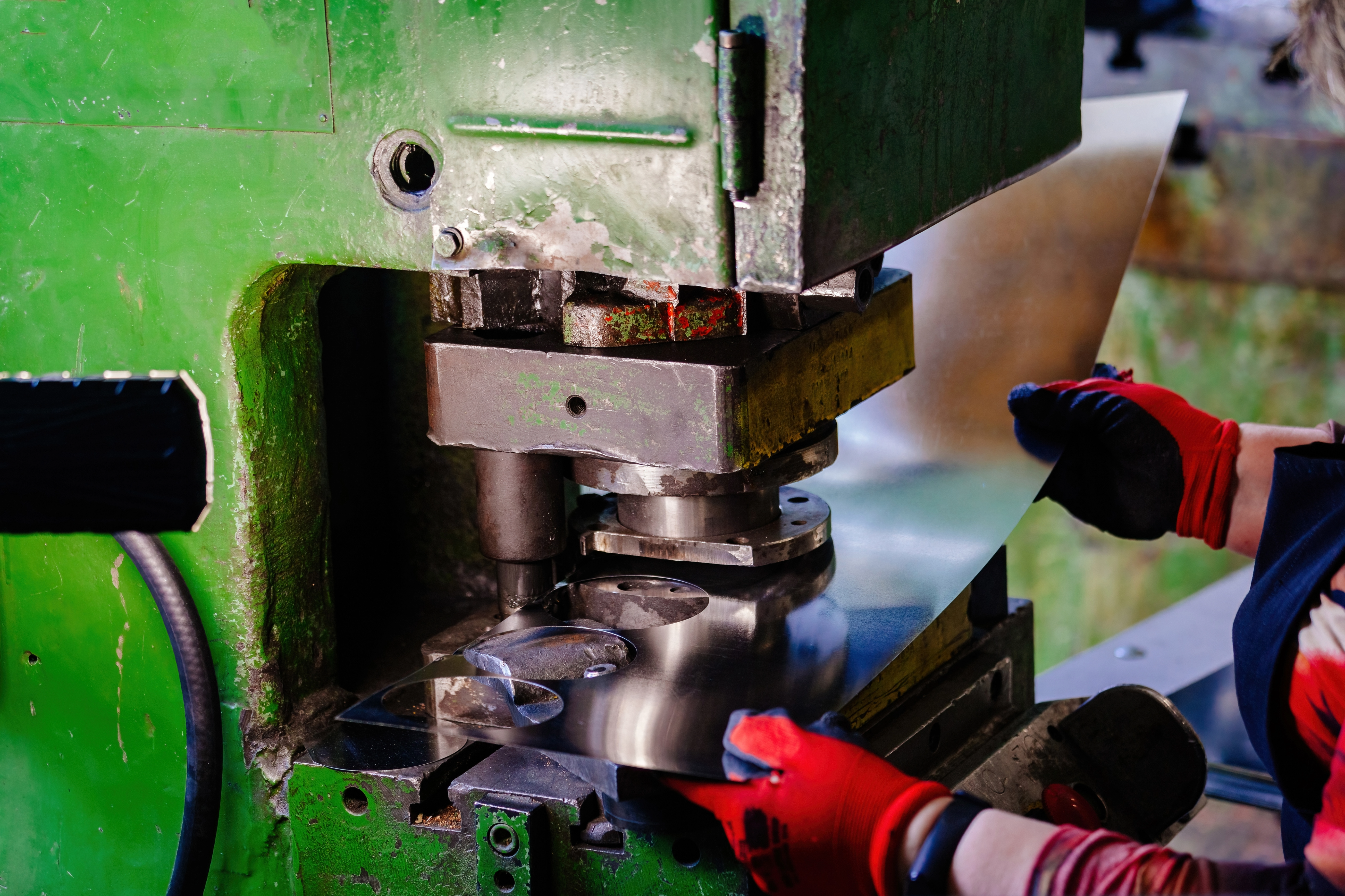
Precision metal stamping is one of the most overlooked “scaling levers” in robotics. When a joint design moves from prototypes to production, stamped components can reduce cost and variability while improving assembly repeatability—especially for parts that are thin, planar, and feature-dense.
In robotic joints (including humanoids), stamping is most useful for:
- motor and actuator laminations
- precision shims and spacers
- spring washers and compliant elements
- flexures, detents, and click-spring features
- thin brackets, retainers, and sensor flags
- shields, covers, and EMI grounding features
Stamping isn’t a replacement for machining everywhere. It’s a complement: stamp what should be thin and repeatable; machine what must be thick, 3D, or tightly controlled in true position to complex datums.
Why stamping fits robotic joints so well
Robotic joint assemblies combine tight packaging, repeated cyclic loads, and a lot of “small but critical” parts that drive stack-up. Stamping is strong when your goals are:
- Controlling stack height
Stamped shims and washers are often the fastest route to predictable preload, backlash control, and bearing/gear alignment.
- Repeatability at volume
Once tooled, stamping can produce highly consistent features per stroke, reducing manual rework and selective assembly.
- Thin feature complexity
Slots, windows, tabs, lances, and formed features can be integrated into one part that would otherwise require multiple machining ops.
- Cost and throughput
Progressive dies can produce parts at very high rates with low marginal labor, making it attractive for medium-to-high volume robots.
Common stamped parts inside robotic joint assemblies
1) Motor and actuator laminations
Electric motors used in joints rely heavily on stamped laminations (stator/rotor stacks). These are typically stamped from electrical steel and then stacked/bonded.
Reference (electrical steel overview and why it’s used for laminations):
https://en.wikipedia.org/wiki/Electrical_steel
2) Precision shims and spacers
Shims are used to tune:
- bearing preload
- gear mesh and backlash
- axial endplay of shafts
- sensor gap and magnet/encoder spacing
Stamped shims can be made in controlled thicknesses and consistent OD/ID profiles. They’re also easy to standardize across multiple joint sizes.
3) Spring elements and compliant components
Examples:
- wave springs, spring washers, finger springs
- detents and click-springs for serviceable modules
- thin flexures for cable retention or sensor compliance
Reference (spring steel concept and common alloys):
https://en.wikipedia.org/wiki/Spring_steel
4) Retainers, tabs, brackets, and “assembly helpers”
Stamped brackets often replace small machined parts that mostly exist to hold something in a repeatable location (switch flags, endstop tabs, strain reliefs).
5) Shields, covers, and EMI grounding parts
Stamped shields, grounding fingers, and covers can be integrated into the mechanical stack to reduce noise, protect encoders, and create more robust harness routing.
Reference (EMI shielding basics):
https://en.wikipedia.org/wiki/Electromagnetic_shielding
Stamping process options and what they’re good for
Progressive die stamping
Best for: high volume, feature-rich parts, multi-step forming, piercing + forming in one tool
Why it matters in robotics: it can produce a “finished” part with multiple features and formed geometry per cycle.
Reference (progressive die concept):
https://en.wikipedia.org/wiki/Progressive_die
Fine blanking
Best for: very clean edges, near-square edge profiles, better flatness and tight edge quality versus conventional stamping
Use cases in joints: precision washers, gear-like profiles in thin steel, parts where edge condition matters for fit or motion.
Reference (fine blanking overview):
https://en.wikipedia.org/wiki/Fine_blanking
Four-slide / multi-slide forming
Best for: complex formed wire/strip parts, clips, springs, retaining features
Use cases: cable clips, detents, spring contacts, small formed retainers.
Reference (multi-slide forming overview):
https://en.wikipedia.org/wiki/Fourslide
Coining, embossing, and forming
Best for: local thickness control, stiffening ribs, features for assembly and anti-rotation
Use cases: stiffeners on thin covers, embossed datum bumps, coining for controlled contact points.
Reference (coining as a forming process):
https://en.wikipedia.org/wiki/Coining_(metalworking)
Stamping vs CNC machining vs laser cutting for joint parts
When stamping wins
- You need hundreds to millions of parts over product life
- The part is thin (sheet/strip) and mostly 2D with light forming
- You want repeatability and low piece price
- You want to integrate multiple features without multiple operations
When CNC machining wins
- The part is thick, 3D, or has tight GD&T relationships to multiple datums
- You’re still iterating geometry weekly
- You need very small quantities or highly customized variants
When laser/waterjet wins
- Prototypes and low volume, flat parts, fast turnaround
- But: laser cut edges and HAZ can be undesirable for fatigue or spring parts unless controlled and post-processed
Reference (laser cutting basics, including heat effects):
https://en.wikipedia.org/wiki/Laser_cutting
A typical robotics scaling path:
Laser/prototype → soft tooling/short-run stamping → progressive die for production
Materials that make sense for robotic joint stamping
Stainless steels (302/304/301, 17-7 PH for springs)
Good for: corrosion resistance, sweat/humidity, thin formed clips and shields
17-7 PH is commonly used for spring applications requiring corrosion resistance.
Reference (17-7 PH stainless overview):
https://en.wikipedia.org/wiki/17-7_stainless_steel
Carbon steels and alloy steels
Good for: brackets, retainers, low-cost formed components
Often paired with coatings (zinc, phosphate, e-coat) for corrosion control.
Reference (zinc plating overview):
https://en.wikipedia.org/wiki/Electroplating#Zinc_plating
Spring steels (1074/1075/1095, etc.)
Good for: compliant parts, detents, spring washers
Watchouts: edge condition and heat treat strategy matter a lot for fatigue.
Reference (spring steel overview):
https://en.wikipedia.org/wiki/Spring_steel
Electrical steels (silicon steels)
Good for: motor laminations
These are selected for magnetic performance, not structural strength.
Reference:
https://en.wikipedia.org/wiki/Electrical_steel
Tolerances, flatness, burrs, and what actually matters in joints
In robotic joint assemblies, the most important stamped-part “quality drivers” are often:
1) Burr direction and edge condition
Burrs can:
- interfere with bearing seating or shim stacking
- create debris that contaminates encoders
- act as stress risers in fatigue-loaded flexures/springs
Best practices:
- Specify burr direction and allowable burr height
- Consider deburring, tumbling, or edge conditioning
- For fatigue-critical spring parts, avoid sharp laser-like notches and uncontrolled microcracks
Reference (burrs in machining/manufacturing context):
https://en.wikipedia.org/wiki/Burr_(edge)
2) Thickness control and stack-up
For shims and washers: thickness tolerance is usually more important than XY profile tolerance.
3) Flatness and part distortion
Thin parts can dish or warp due to:
- residual stresses in strip
- forming sequence
- plating stresses
- heat treat
You may need:
- leveling/flattening ops
- material selection changes
- better forming strategy (or fine blanking)
4) Hole quality and positional needs
If the stamped part is used as a datum for an encoder flag or sensor alignment, hole true position may become critical—this sometimes pushes toward fine blanking, secondary machining, or a different datum scheme.
Design for Manufacturability tips for stamped robotic joint parts
Geometry and feature rules that reduce cost and risk
- Use standard radii and avoid tiny inside corner radii that force fragile punches
- Keep minimum web widths reasonable (thin webs tear or distort)
- Avoid long skinny slots that cause distortion in thin strip
- Prefer round holes when possible (most robust, cheapest to maintain)
Formed features that help assembly
- Embossed “datum bumps” to create controlled stand-offs
- Lance tabs for anti-rotation and quick assembly
- Coined areas for predictable electrical contact or grounding
Spring parts: design like fatigue matters
- Use generous radii at transitions
- Avoid sharp inside corners
- Specify edge conditioning if the part cycles
- Validate with real cycle testing (don’t rely on static strength)
Coatings and finishes for robotics environments
Robots see sweat, humidity, cleaners, and galvanic couples (stainless + aluminum + carbon fiber). Typical finish strategies:
- Stainless (passivated) for exposed clips and shields
Reference (passivation basics): https://en.wikipedia.org/wiki/Passivation_(chemistry)
- Zinc plating for cost-sensitive steel parts (fasteners/brackets)
Reference: https://en.wikipedia.org/wiki/Electroplating#Zinc_plating
- Phosphate + oil for wear interfaces or assembly-friendly surfaces
Reference (phosphate coating): https://en.wikipedia.org/wiki/Phosphate_coating
- E-coat for corrosion protection on formed brackets (common automotive-style approach)
Reference (electrophoretic deposition / e-coat concept): https://en.wikipedia.org/wiki/Electrophoretic_deposition
Important: coating thickness can change fits and stack height. For shims and stack-critical parts, control coating strategy carefully or avoid coating on the functional faces.
Quality control and validation for stamped joint components
What to inspect early
- Thickness distribution (especially for shims)
- Burr height and direction
- Flatness and bow
- Feature location that influences sensor alignment
- Plating thickness and adhesion (if plated)
What to validate in the assembly
- Preload consistency across builds
- Backlash variation after torque cycling
- Encoder signal stability (no debris shedding)
- Noise/vibration changes from stack variation
Cost and lead-time drivers you should plan for
Stamping economics are dominated by:
- die complexity (number of stations, forming steps)
- tool steel selection and expected maintenance
- material yield (nesting efficiency)
- secondary operations (deburr, heat treat, plating, flattening)
- inspection and packaging (preventing scratches/bends on thin parts)
Rule of thumb for robotics teams:
If the part is stable and you’ll build the same joint many times, stamping pays back quickly—especially for shims, retainers, and brackets that otherwise consume machining time.
RFQ checklist for precision stamped parts used in robotic joints
- Part function: shim / spring / bracket / lamination / shield / retainer
- Material spec + temper/hardness (and grain direction if relevant)
- Thickness tolerance and which faces matter for stack height
- Flatness requirement and measurement method
- Burr direction + max burr height
- Edge condition requirement (deburr, tumble, brush, etc.)
- Coating/finish (and whether coating is allowed on functional faces)
- Quantity (prototype, pilot, annual volume)
- Packaging requirements (thin parts bend easily—define handling)
- Any assembly-critical dimensions and datums
Outbound references used in this guide
Electrical steel: https://en.wikipedia.org/wiki/Electrical_steel
Spring steel: https://en.wikipedia.org/wiki/Spring_steel
EMI shielding: https://en.wikipedia.org/wiki/Electromagnetic_shielding
Progressive die: https://en.wikipedia.org/wiki/Progressive_die
Fine blanking: https://en.wikipedia.org/wiki/Fine_blanking
Fourslide forming: https://en.wikipedia.org/wiki/Fourslide
Coining: https://en.wikipedia.org/wiki/Coining_(metalworking)
Laser cutting: https://en.wikipedia.org/wiki/Laser_cutting
Burrs: https://en.wikipedia.org/wiki/Burr_(edge)
Passivation: https://en.wikipedia.org/wiki/Passivation_(chemistry)
Phosphate coating: https://en.wikipedia.org/wiki/Phosphate_coating
Electrophoretic deposition (e-coat): https://en.wikipedia.org/wiki/Electrophoretic_deposition
Zinc plating: https://en.wikipedia.org/wiki/Electroplating#Zinc_plating
Takeaways
- Precision stamping is a strong fit for robotic joints when parts are thin, repeatable, and drive stack-up or assembly speed.
- The biggest reliability wins come from controlling thickness, flatness, burrs, and edge quality, not just XY dimensions.
- Many robotics platforms scale best with a hybrid approach: stamp the thin functional layers; machine the thick structural datums.