


Sports have always relied on precision. From the placement of a football after a contested first-down to determining whether a soccer player was offside by inches, small moments can change the outcome of an entire game. For decades, these decisions depended almost entirely on the human eye. Today, advanced camera tracking systems and artificial intelligence are transforming how sports are played, officiated, and experienced.
Behind every automated call and real-time statistic is a complex combination of cameras, sensors, software, and precision-engineered hardware. While the technology itself is impressive, bringing these systems from concept to reality requires more than innovation alone. Companies developing sports technology must also overcome the challenges of designing, manufacturing, and scaling reliable equipment that performs in demanding environments.
The Rise of Camera Tracking in Sports
Camera tracking technology uses networks of high-speed cameras, artificial intelligence, and data-processing systems to monitor movement with incredible accuracy. These systems can track the location of athletes, equipment, and game objects in real time, creating new opportunities for performance analysis, more accurate officiating, and fan engagement.
Unlike traditional broadcast cameras, which primarily capture images for viewers, tracking cameras collect precise spatial data. By analyzing thousands of data points per second, these systems can determine exact positioning, movement patterns, and interactions on the field or court.
As sports become increasingly data-driven, camera tracking has become a critical tool for leagues, teams, and technology companies looking to improve accuracy and create better experiences for athletes and fans.
Closer Look: FIFA’s Semi-Automated Offside Technology

One of the most visible examples of camera tracking in sports is FIFA’s semi-automated offside technology. Used in major international competitions, including the FIFA World Cup, the system uses specialized cameras positioned throughout the stadium to track player movements and analyze players’ exact positions during critical moments.
The technology combines multiple camera angles with artificial intelligence to create a three-dimensional representation of players on the field. By tracking individual body points, the system can determine whether a player was offside when the ball was kicked.
This technology helps referees make faster, more accurate decisions while reducing uncertainty during game-changing moments. Implementing a system this precise requires highly reliable hardware. Cameras must operate continuously, withstand demanding stadium environments, and perform consistently across different lighting conditions and viewing angles.
The success of these systems depends not only on advanced software, but also on the engineering and manufacturing of the physical components that support them.
Closer Look: The NFL’s Ball Tracking Technology
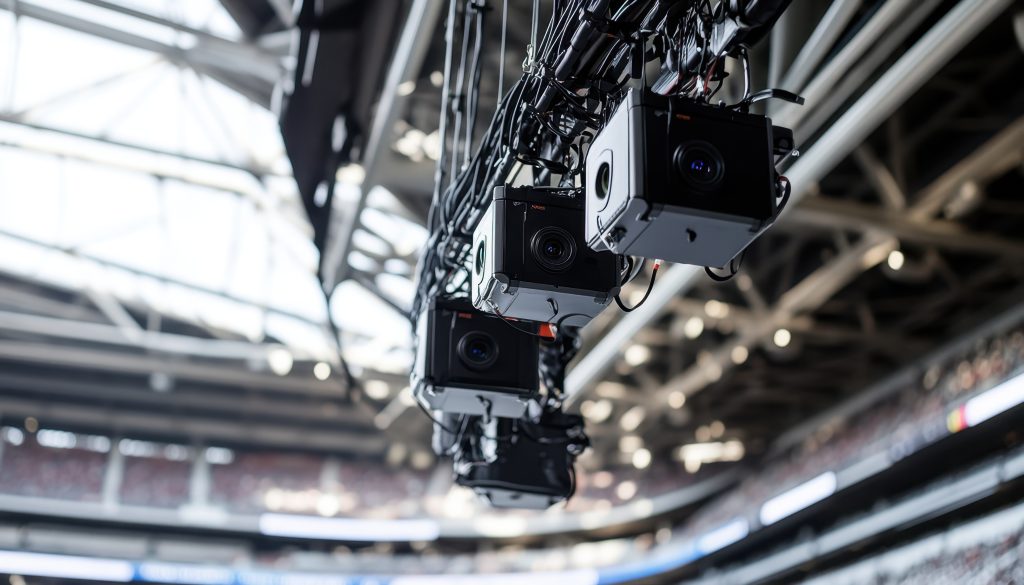
The NFL has also embraced advanced tracking technology to improve game accuracy and efficiency. Through Sony’s camera-based “Hawk-Eye” tracking systems, officials can more precisely determine football placement, player positioning, and movement during plays.
Accurate ball placement is especially important in situations involving first downs, goal-line decisions, and close calls where inches can determine the outcome of a game. High-resolution cameras and tracking systems help officials analyze plays more efficiently and provide additional data to support decision-making.
The Manufacturing Challenges Behind Sports Technology
While camera tracking systems may seem primarily software-driven, their success depends on sophisticated manufacturing and engineering.
Companies developing sports technology must consider:
Reliable Hardware Production
Tracking systems require components that perform consistently, including:
- High-resolution cameras
- Protective housings
- Mounting systems
- Electronic components
- Precision-machined parts
- Weather-resistant enclosures
Every component must meet strict quality standards, as even a small hardware failure can impact the accuracy of an entire system.
Design for Manufacturing and Assembly
Innovative technology often begins as a prototype. However, moving from a prototype to a reliable production system requires careful engineering.
Manufacturers must evaluate:
- Material selection
- Component tolerances
- Assembly processes
- Production costs
- Long-term durability
Designs that work in a prototype environment may require significant adjustments before they can be manufactured consistently at scale.
Supply Chain Management
Advanced sports technology often combines multiple disciplines, including electronics, mechanical components, plastics, and software.
Managing these complex supply chains requires coordination between suppliers, engineers, and manufacturers to ensure every component meets performance expectations.
How E-BI International Supports Sports Technology Companies
As sports continue to integrate advanced technology, companies need manufacturing partners that can turn innovative ideas into reliable products.
E-BI International helps companies bridge the gap between product development and scalable manufacturing. By working closely with clients throughout design and production, E-BI’s engineering teams help transform concepts and prototypes into products built for efficient manufacturing.
E-BI supports companies through:
- Design for manufacturability (DFM) and design for assembly (DFA)
- CNC machining
- Plastic injection molding
- Die casting
- Supplier identification and coordination
- Quality inspection
- Product testing
- Packaging and production support
Whether developing camera housings, precision components, connected sports equipment, or other advanced technology systems, E-BI helps companies ensure their products are innovative, manufacturable, repeatable, and scalable.
The Future of Sports is Built on Manufacturing Innovation
Camera tracking technology is changing the way athletes compete, coaches strategize, and fans experience sports. However, the future of sports technology depends on more than groundbreaking ideas—it depends on the ability to manufacture those ideas reliably.
As sports technology advances, companies must ensure their products can withstand real-world conditions, maintain consistent performance, and scale to meet growing demand.
By combining engineering expertise with manufacturing capabilities, E-BI International helps innovative companies bring the next generation of sports technology from the drawing board to the field, court, and stadium.