

Mobile robots—AMRs, delivery bots, inspection units, security patrols, hospital assistants—face constant movement, impacts, weather exposure, and tight cost targets. The housing (chassis, cover panels, battery trays, sensor mounts) must be lightweight, strong, rigid, EMI-shielded, and economical to produce in volume. Metal forming processes (stamping, extrusion, bending, roll-forming, and forging) are the most widely adopted solution for these requirements. As a specialist in precision metal forming, E-BI manufactures formed metal housings and structural components in its facilities in China, Vietnam, and Thailand. This article explains why metal forming remains essential for mobile robot housing and how E-BI enables reliable, scalable production.
Why Metal Forming Outperforms Alternatives for Mobile Robot Housings
Injection-molded plastic is common for consumer devices, but mobile robots in warehouses, hospitals, campuses, and urban environments need superior impact resistance, rigidity, heat dissipation, and EMI shielding. Metal forming delivers these advantages at competitive cost in medium-to-high volumes.
Core Advantages of Formed Metal Housings
- Superior impact & drop resistance — survives repeated collisions with walls, curbs, people
- High stiffness & dimensional stability — minimizes deflection under payload or during fast acceleration
- EMI/RFI shielding — steel or aluminum housings block electromagnetic interference from motors and nearby equipment
- Heat dissipation — metal conducts heat away from batteries, motors, and controllers
- Cost-effective at scale — progressive stamping or roll-forming costs drop dramatically above 10,000–50,000 units
- Long service life — 5–10+ years of daily use without cracking or warping
Most Common Metal Forming Processes for Mobile Robot Housings
1. Progressive Die Stamping
Used for: battery trays, top covers, side panels, sensor brackets, wheel guards.
Advantages: high speed (20–100 parts/min), complex features in one stroke, excellent repeatability.
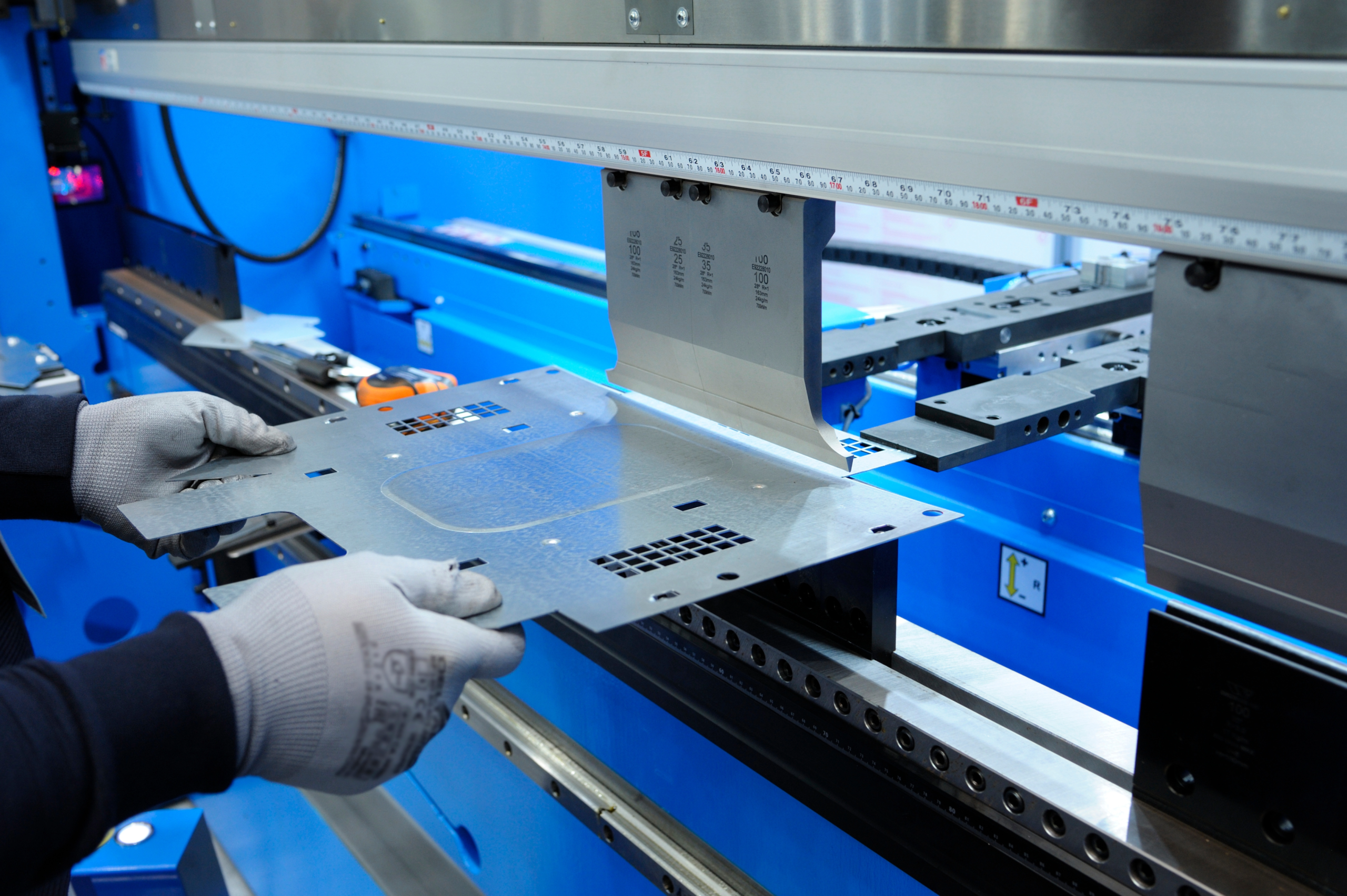
2. CNC Bending
Used for: custom enclosures, access panels, L-shaped frame members, cable management channels.
Advantages: no dedicated tooling for most bends, quick setup for small-to-medium runs, tight angular accuracy.
3. Aluminum Extrusion + Secondary Bending/Machining
Used for: main chassis rails, cross-members, payload platforms, mast structures.
Advantages: modular T-slot design, high stiffness-to-weight, easy integration of linear guides.
4. Roll Forming
Used for: long guide rails, conveyor side channels, structural stringers.
Advantages: continuous long lengths, integrated tracks or cable channels, very low cost per meter.
E-BI’s Metal Forming Capabilities for Mobile Robots
E-BI combines multiple forming technologies under one roof to produce complete housing assemblies for mobile robots.
High-Volume Stamping & Bending
Progressive dies (80–600 ton) for covers and trays; 6-axis CNC press brakes for complex bends; tolerances ±0.05–0.1 mm.
Extrusion & Roll Forming
Custom aluminum profiles with integrated features; roll-formed steel rails up to 12 m; secondary CNC machining & assembly.
Ruggedization & Finishing
IP54–IP67 enclosures, powder coating/e-coat for corrosion resistance, vibration-damping mounts, EMI shielding gaskets.
Regional Manufacturing Advantages
China offers high-tonnage stamping and fast tooling. Vietnam and Thailand provide cost-competitive, high-volume production with short shipping times to North America, Europe, and Asia-Pacific markets IndustryWeek.
Challenges in Metal Forming for Mobile Robot Housings
Key challenges include:
- Balancing weight & impact resistance for battery-powered mobility
- Achieving tight tolerances on multi-bend or deep-drawn parts
- Maintaining flatness after forming high-strength materials
- Ensuring EMI shielding without adding excessive weight
- Meeting aggressive cost targets for mass-market delivery robots
E-BI overcomes these through material optimization, advanced die simulation, real-time angle measurement, and hybrid forming (stamping + extrusion + bending) Wiley.
Powering Autonomous Delivery & Mobile Robotics with E-BI
Stamped, bent, extruded, and roll-formed metal components deliver the durability, precision, EMI protection, and cost-efficiency needed for autonomous delivery robots to succeed in real-world urban environments. E-BI’s multi-process metal forming expertise in China, Vietnam, and Thailand enables robotics companies to scale reliable, lightweight housings at competitive prices.
For teams developing sidewalk delivery bots, indoor AMRs, campus shuttles, or last-mile logistics platforms, partnering with E-BI provides a strategic advantage. Our proven sheet metal forming capabilities and regional strengths can help you build tough, efficient, and economical mobile robots. Connect with E-BI today to form the future of autonomous delivery.